For GP practices, pharmacies and immunisation clinics

What the Green Book requires of vaccine storage

Chapter 3 of the Green Book expects vaccines to be kept at +2 °C to +8 °C in a specialised pharmaceutical fridge, with the temperature monitored continually and the maximum, minimum and current readings recorded at least once each working day. When the fridge goes out of range, you quarantine the stock, keep it cold, record what happened and get advice before using or discarding it.

Updated 18 October 2026Reviewed by Jake Farrow, Managing Director

At a glance

What it asks

The rule in pictures

The range, and what a daily check can and can't see

The Green Book range is fixed. What changes is how much of the day your records actually show.

Vaccine fridge: 2 to 8 °CIllustrative
  • Green Book storage range, +2 to +8 °C
  • Alarm limits set inside it, so someone acts before stock is at risk

Aim for +5 °C, the midpoint. The alarm limits shown are an example; set yours from your fridge's behaviour and your sensor's uncertainty.

What each method tells youIllustrative
Daily min/max readingThe highest and lowest since the last reset, but not when or for how long
Continuous monitoringEvery reading, with the time it left range, the peak and the duration

The Green Book requires the daily record either way. Continuous monitoring adds the timing a risk assessment needs.

Green Book ch. 3

The fridge: specialised, safe and serviced

What it says

Store vaccines in their original packaging, according to the manufacturer's summary of product characteristics (SPC), usually at +2 °C to +8 °C and protected from light. Good practice is to aim for +5 °C. Use specialised refrigerators for pharmaceutical products; ordinary domestic fridges must not be used, and food, drink and clinical specimens must never share the fridge. Each fridge should have a unique identifier, be lockable or in a locked room, sit in a ventilated spot away from heat, and have a maintenance contract that allows for at least yearly servicing and calibration of the temperature gauge. Reduce the chance of the power being switched off, for example with a switchless socket or a labelled plug.

What it means on site

Over-full fridges are the common gap: packs pressed against the back wall can freeze, and freezing destroys some vaccines outright. The other is the fridge that was bought for flu season and never added to the servicing contract.

How to evidence it

  • A list of vaccine fridges with their unique identifiers and locations
  • Servicing, defrosting, cleaning, calibration and electrical testing records, kept on a log with each fridge
  • The maintenance contract covering yearly servicing and calibration
  • Names of the two (or more) people nominated for vaccine ordering, receipt and care

Green Book ch. 3

Thermometers: continual, independent, calibrated

What it says

Monitor the temperature inside the vaccine fridge continually with a maximum–minimum thermometer, so you can tell when it may have been out of range. Use at least one max/min thermometer that is independent of mains power, as well as any thermometer built into the fridge, so you still have readings during a power cut. Calibrate it annually. If checks suggest the thermometer is faulty, consider what that means for stock stored and recently given, inform the provider or commissioning organisation and make servicing a priority.

What it means on site

The built-in display on the fridge is often the only thermometer, and it goes dark with the power. An independent sensor with its own battery keeps recording through the outage, which is exactly the period you'll be asked about.

How to evidence it

  • A calibration certificate for each independent thermometer or sensor, less than a year old
  • A record that the thermometer on the certificate is the one in the fridge today
  • What you did the last time a thermometer was found faulty

Green Book ch. 3

Daily records: the four Rs

What it says

Monitor and record fridge temperatures at least once each working day on a temperature chart. Read the maximum, minimum and current temperatures at the same time each day; record them in a standard way and sign each entry; reset the thermometer after each reading; and react, documenting the action, if the temperature falls outside +2 °C to +8 °C. Keep the records readily accessible for at least one year and covering the full storage history of the products in the fridge; as shelf lives can be four years or longer, keeping them for five years will generally do that. Monitor cool boxes when in use, recording at the start and end of each session.

What it means on site

Monday morning is where paper records struggle. A max/min reading taken after a weekend shows the fridge reached +11 °C, but not whether that was for ten minutes on Saturday or all of Sunday. That difference decides whether the stock can be used.

How to evidence it

  • Signed daily temperature records for each fridge, for at least a year
  • Records that cover the whole time current stock has been in the fridge
  • Each out-of-range reading with the action taken written beside it
  • Cool box readings at the start and end of each session

Green Book ch. 3

When the fridge fails or the cold chain breaks

What it says

Have back-up arrangements for when a fridge fails. Local protocols should cover keeping the door closed until the situation has been assessed, informing the provider or commissioning organisation and the local immunisation lead, establishing the last reliable reading and the timing and cause of the excursion, quarantining affected vaccines in the cold chain with clear labels, recording all details and disposing of vaccines only if they're judged unusable. Vaccines stored outside their recommended conditions are outside their marketing authorisation; any decision to use them is the user's, made case by case on the stability evidence. UKHSA's vaccine incident guidance adds that a one-off rise above +8 °C lasting under 20 minutes, such as during restocking, is unlikely to have breached the cold chain, but the cause should still be documented.

What it means on site

The question that decides the stock is how long and how warm. If your records can't say when the excursion started, you can't rely on UKHSA's 20-minute allowance or the manufacturer's stability data with any confidence, and stock may be destroyed that didn't need to be.

How to evidence it

  • Your local cold chain protocol and back-up fridge arrangements
  • For each incident: last reliable reading, start, peak, duration and cause
  • Quarantine labels and where the stock was held
  • The advice you received (manufacturer, pharmacist or immunisation team) and the decision on the stock

In the inspector's words

Questions to be ready for

The kind of questions an inspector, assessor or auditor puts. If you can answer each with a record, you're ready.

  1. “Show me this fridge's temperature records for the last month. Who signed them?”
  2. “What does this thermometer read if the power goes off?”
  3. “When was it last calibrated? Is this the certificate for it?”
  4. “This reading says +10 °C. What did you do, and where is that written down?”
  5. “What happens to the vaccines if this fridge fails on a Friday night?”
  6. “Who are the named people responsible for the vaccines here?”

Where JTF fits

Where JTF fits

We fit wireless sensors with their own batteries in each vaccine fridge, so readings continue through a power cut, and Sematics, our monitoring platform, records every reading and sends alarms that reach a person out of hours. Every sensor we supply comes with calibration: traceable to national standards as standard, or UKAS accredited where you need it (temperature in our own UKAS accredited calibration laboratory No. 10723; other parameters through accredited partners). Your daily Green Book record stays your team's job; Sematics gives them the timeline behind it, so a weekend excursion shows when it started, how warm it got and for how long.

Checklist

MHRA GDP and Green Book temperature checklist

The Green Book's rules for vaccine fridges, and MHRA GDP for wholesale, on one A4 sheet.

Download the checklist

Free download

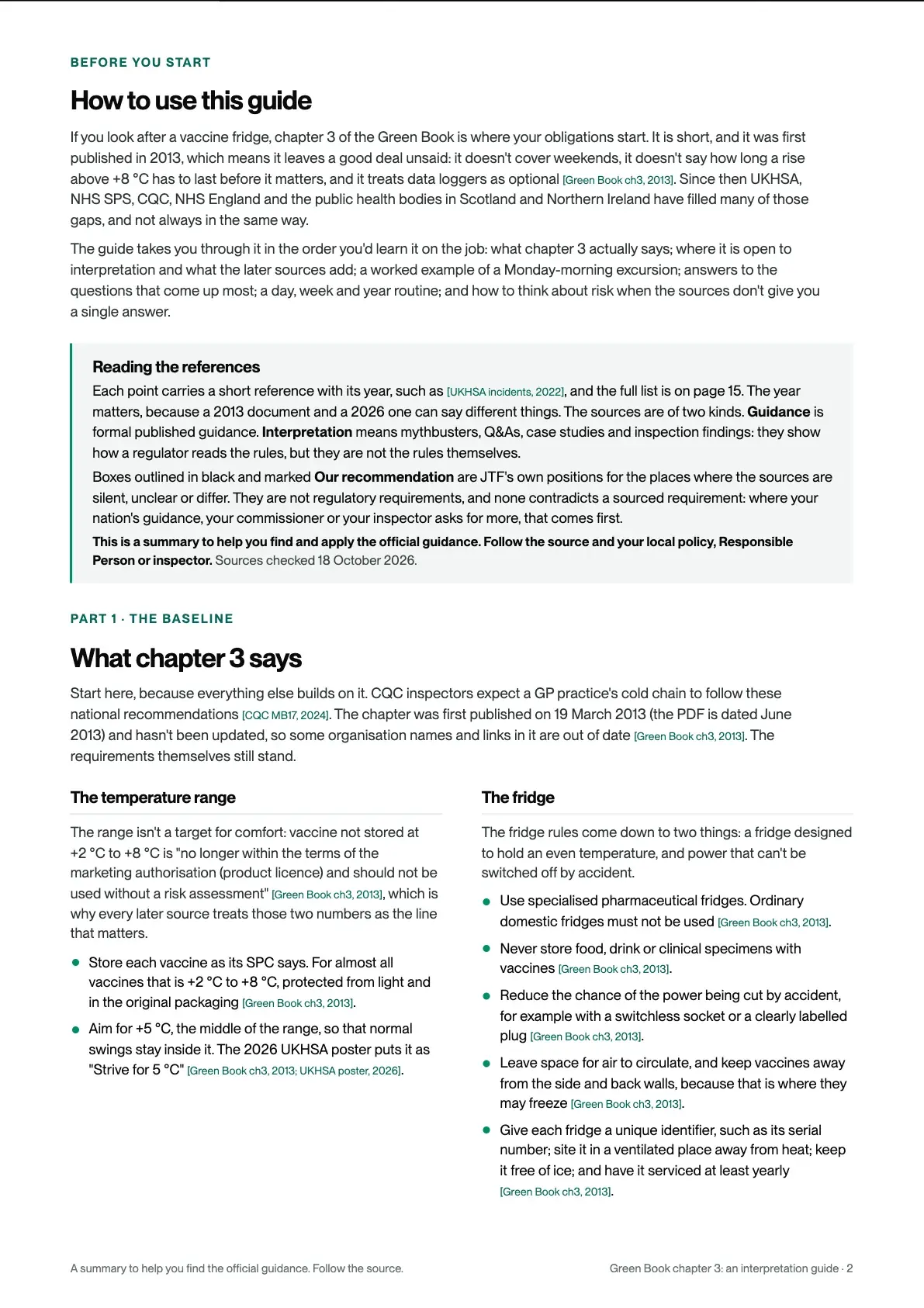
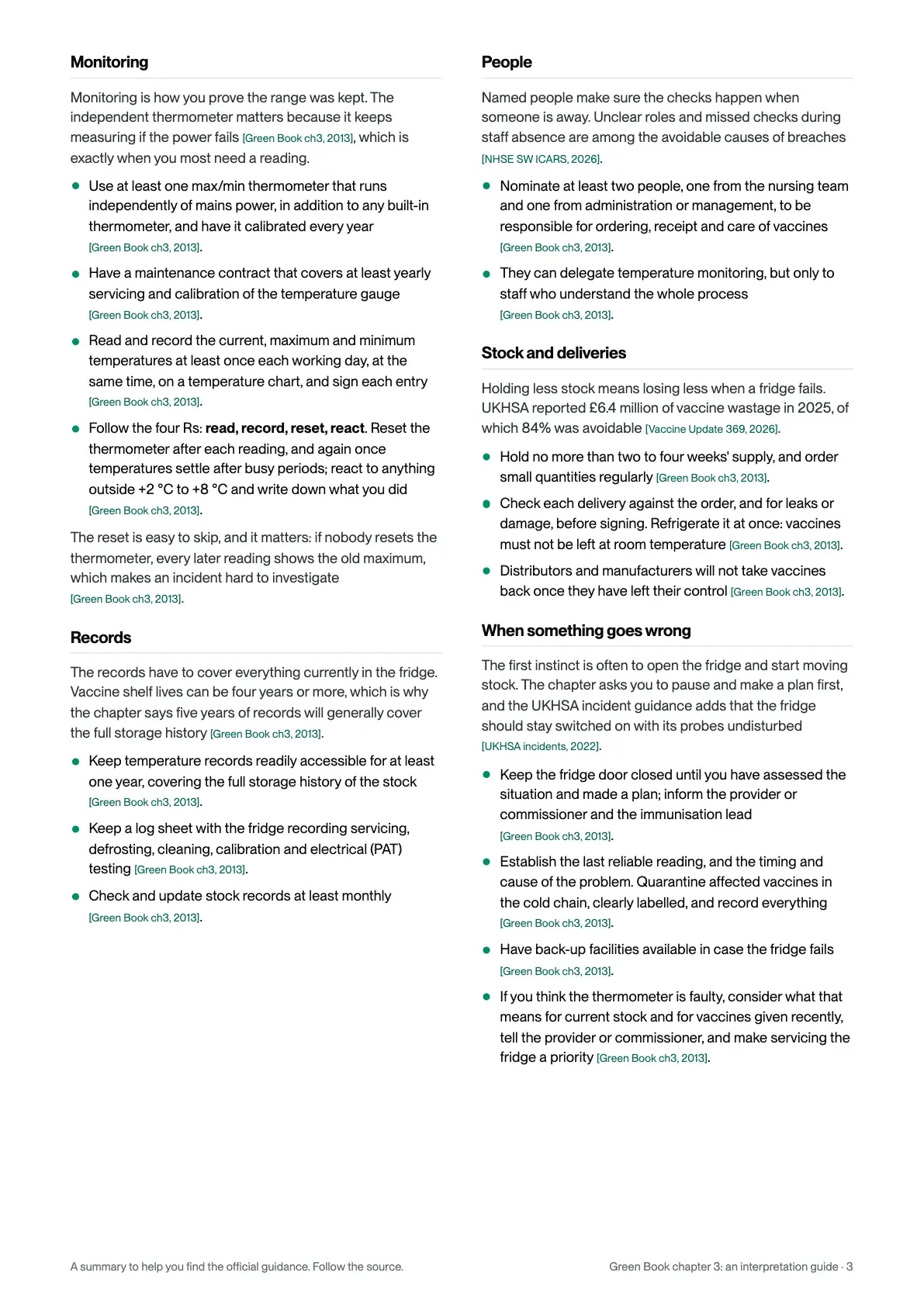
Green Book chapter 3: an interpretation guide

Fifteen pages for your practice or pharmacy file: what chapter 3 says, where it's open to interpretation, what UKHSA, SPS, CQC and the devolved guidance add, practical answers, a worked example, a day, week and year routine, and our risk-based recommendations where the sources are silent. Every point sourced and dated.

  • Page 1 of Green Book chapter 3: an interpretation guide, preview
  • Page 2 of Green Book chapter 3: an interpretation guide, preview
  • Page 3 of Green Book chapter 3: an interpretation guide, preview

A summary to help you find and apply the official guidance. Follow the source and your local policy, Responsible Person or inspector.

Tell us where to send it. The link appears as soon as you press the button.

We use your details to reply to this request, nothing else. See our privacy notice.

The 20-minute compliance check

See your own gaps, in writing

A free call with one of our specialists, then a branded report of what an inspector would find, yours to keep. This is an example.

Example reportExample report: medicines storageA hospital pharmacy, wards and clinics (fictional)Download the PDF
Example report: medicines storage
Page 1 of the example report: medicines storagePage 2 of the example report: medicines storagePage 3 of the example report: medicines storage

Related

Keep reading

Questions

Common questions

Does the Green Book require a data logger?

No. It requires continual monitoring with a max/min thermometer, at least one independent of mains power, and a daily record. It notes that alarmed digital max/min thermometers and data loggers are now available; a logger adds the timing a min/max can't give.

Can we stop the daily written record if we have continuous monitoring?

The chapter asks for temperatures to be recorded at least once each working day and each entry signed. Many sites keep that daily check, using the monitoring system as the reading, so a person still looks and signs.

Is a brief rise above 8 °C during restocking an excursion?

UKHSA's vaccine incident guidance says a one-off rise above +8 °C lasting less than 20 minutes is unlikely to have breached the cold chain. Record the cause, reset the thermometer and carry on. It applies only to a one-off rise you know lasted under 20 minutes, with vaccines in their original packaging and stored properly before; a max/min reading alone can't show that. It is vaccine guidance, not a GDP allowance: WDA and MIA holders treat every excursion as a deviation.

How long should we keep fridge temperature records?

At least one year, and long enough to cover the full storage history of the stock in the fridge. Because shelf lives can be four years or more, the chapter suggests five years will generally do it.

Should we throw away vaccines after an excursion?

Not straight away. Quarantine them in the cold chain, label them and seek advice. The decision depends on how warm or cold they got, for how long, and the manufacturer's stability data.

On LinkedIn

Rules, results and what inspectors ask, every week.

Follow JTF Wireless for plain-English compliance notes, case studies and news from the lab.

Follow JTF Wireless

Next step

Rather do it in your own time?

The online check takes about 10 minutes of plain-English questions. A specialist reviews your answers and sends you the report.