Healthcare and NHS
350+
assets monitored across three hospitals at University Hospitals of Leicester
Regulation: BSQR and ISO 15189
Read the University Hospitals of Leicester storyUKAS accredited calibration laboratory No. 10723
For temperature sensors, probes, loggers and thermometers
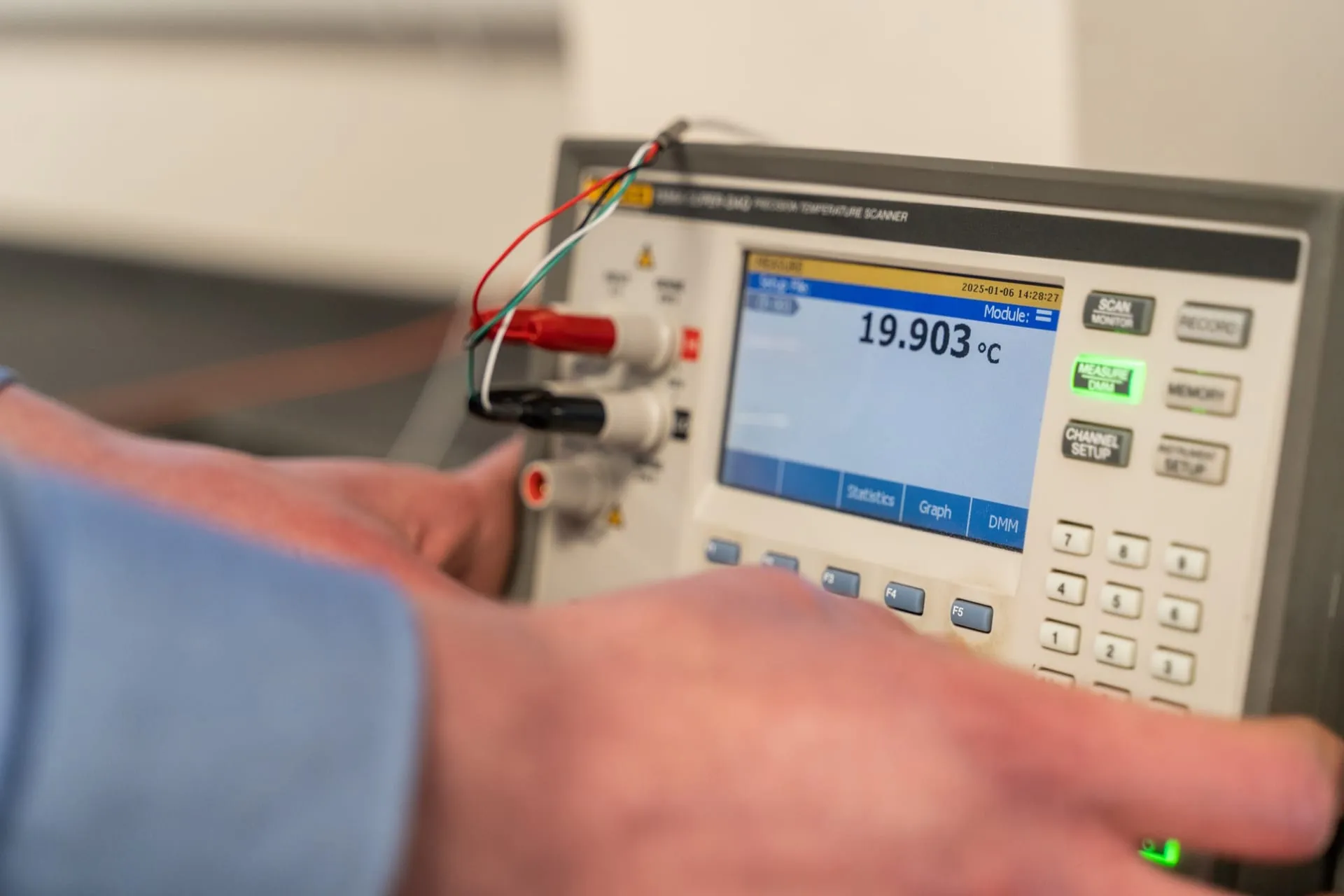
An expired certificate, or one that can't show traceability, can put a year of readings in doubt. Every sensor we supply is calibrated: traceable to national standards as standard, or UKAS accredited where you need it, with temperature calibrated in our own UKAS accredited calibration laboratory No. 10723.
20.02°C
The short answer
Our accreditation as UKAS accredited calibration laboratory No. 10723 (accredited to ISO/IEC 17025) covers temperature indicators and recorders with their sensors: probes and thermometers read with their own display or logger, in a dry block from −90 °C to +135 °C, and whole loggers and wireless sensors in an air chamber from −35 °C to +40 °C, in our lab or on site. Bare probes without an indicator, liquid-in-glass and infrared thermometers are not on our scope. Humidity, CO₂ and other parameters go to accredited partner laboratories, which issue their own certificate under their own UKAS accreditation number. 10723 is our UKAS laboratory number; ISO/IEC 17025 is the standard we're accredited to.
UKAS accredited calibration laboratory No. 10723
Accredited to ISO/IEC 17025 for temperature calibration, in our Tamworth lab and on site. 10723 is our UKAS laboratory number; ISO/IEC 17025 is the standard we're accredited to. Our accreditation is limited to those activities described on our UKAS schedule of accreditation, found here.
Not covered by this accreditation: monitoring, mapping, validation, our traceable (non-accredited) calibrations, and calibration of humidity, CO₂ and other parameters, which go to accredited partner laboratories.
The lab in figures
In our Tamworth lab or on your site. Anything outside these ranges, and humidity, CO₂ and other parameters, go to accredited partners.
10,000+
sensor calibrations a year
Traceable and UKAS accredited, across our own lab and our accredited partners.
3,000+
UKAS accredited calibrations a year
UKAS accredited calibrations a year. We tell you which you'll get before we start.
No. 10723
our UKAS accredited calibration laboratory number, accredited to ISO/IEC 17025 for temperature
A certificate for every sensor, held against it in Sematics with its due date.
What's included
Traceable calibration as standard. Where you need UKAS, temperature is calibrated in our own UKAS accredited calibration laboratory No. 10723 and other parameters through accredited partners. We tell you which you're getting before we start.
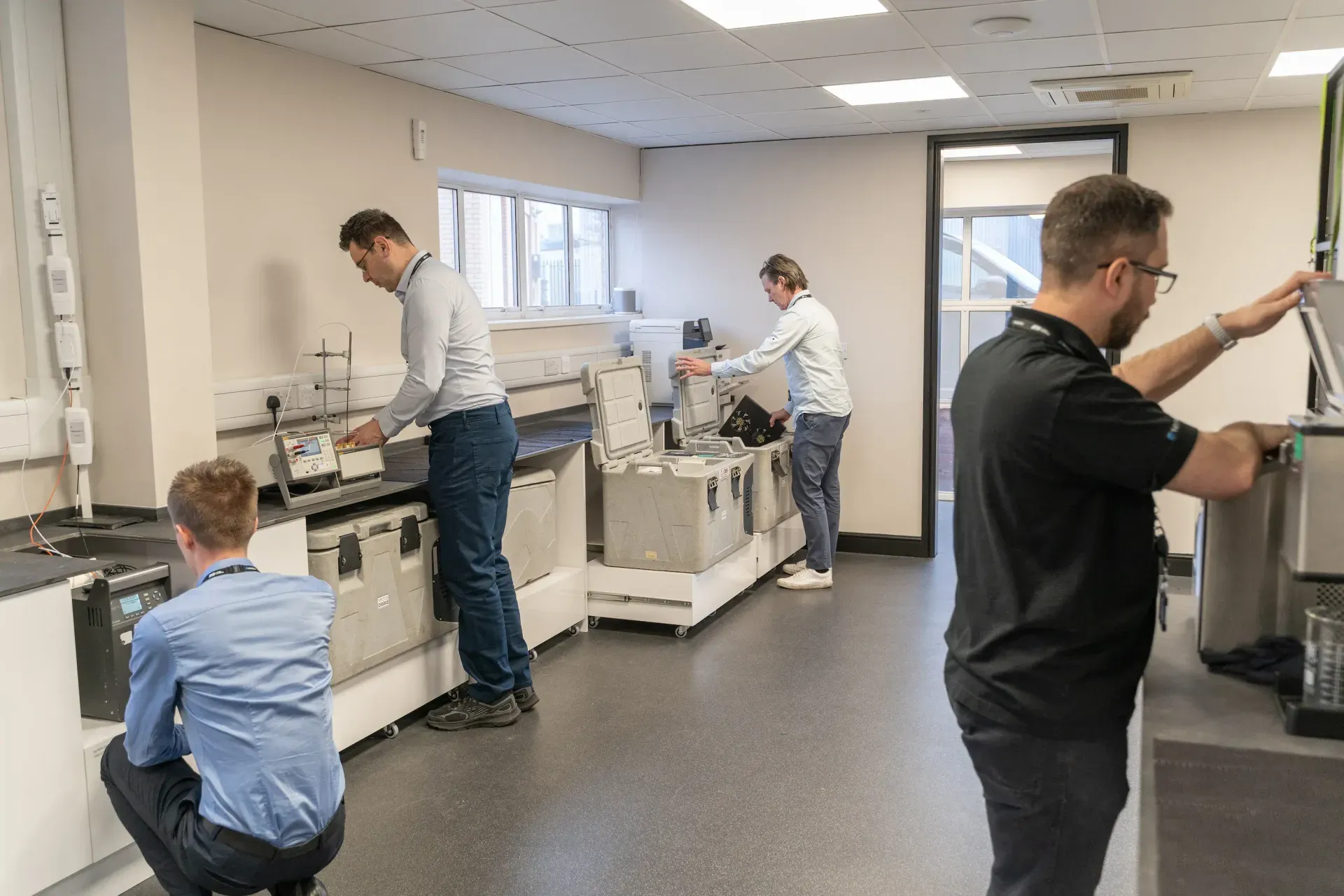
We calibrate at your site, so your sensors never leave the building. New sensors are calibrated in our Tamworth lab before they're installed. Both are within our UKAS scope.
Tested against reference standards traceable to national standards. The lower-cost choice where no standard, customer or regulator asks for UKAS; the certificate carries no UKAS symbol.
For ISO 15189 and ISO/IEC 17025 laboratories, or any customer, contract or regulator that names UKAS. Temperature in our UKAS accredited calibration laboratory No. 10723, with the UKAS symbol, our laboratory number and the uncertainty on every certificate.
Results as found and, where adjusted, as left, with the error and uncertainty at each point. Each certificate sits against its sensor in Sematics, where your nominated user reviews and approves it, as the HPRA, for example, expects.
Humidity, CO₂ and temperatures above our range (Up to +660 °C) go to UKAS accredited partner laboratories, on their own certificates.
Any make of temperature probe, logger or sensor within our scope, not only the ones we supply.
How it works
We agree the sensors, the calibration points and a date, and plan the visit around your work.
Our engineer tests each sensor against a calibrated reference at the agreed points, at your site. Nothing is sent away.
A certificate for each sensor goes onto it in Sematics, marked traceable or UKAS accredited (laboratory No. 10723), or issued by the accredited partner laboratory.
The next due date is set against each sensor, and we contact you before it lapses.
What it covers
From the UKAS schedule of accreditation for UKAS accredited calibration laboratory No. 10723. 10723 is our UKAS laboratory number; ISO/IEC 17025 is the standard we are accredited to.
| What | Range | Best uncertainty (k=2) | Where |
|---|---|---|---|
| Temperature indicators and recorders with their sensors: probes and thermometers read with their own display or logger (dry block) | −90 °C to +135 °C | 0.07 °C | Our lab and on site |
| Temperature indicators and recorders with their sensors: whole loggers and wireless temperature sensors (air chamber) | −35 °C to +40 °C | 0.24 °C | Our lab and on site |
| High-temperature probes and electronic thermometers | Up to +660 °C, through an accredited partner | As stated by the partner lab | Partner lab, on its own certificate |
| CO₂ in incubators, through an accredited partner on site | 0 to 20% CO₂ | As stated by the partner lab | On site, on the partner's own certificate |
| CO₂ gas detectors and analysers, through an accredited partner | 0 to 20% CO₂ | As stated by the partner lab | Partner lab, on its own certificate |
| Humidity and other parameters | Through accredited partner laboratories | As stated by the partner lab | Partner lab, on its own certificate |
Our UKAS accreditation covers temperature calibration only. Bare probes without an indicator, liquid-in-glass and infrared thermometers, and temperatures outside these ranges, aren't on our own scope; high temperatures and CO₂ go through accredited partners, who issue their own certificates under their own UKAS schedules. Traceable calibration is our standard and is not UKAS accredited: we tell you which you're getting before we start.
Healthcare and NHS
350+
assets monitored across three hospitals at University Hospitals of Leicester
Regulation: BSQR and ISO 15189
Read the University Hospitals of Leicester storyWhich rules it serves
What a UKAS-accredited calibration certificate tells you, and what it doesn't.
Read the guideCalibration traceable to national standards, with uncertainty taken into account.
Read the guideMonitoring equipment calibrated at defined intervals (GDP 3.3).
Read the guideTemperature devices identified, calibrated to a schedule and traceable to a recognised standard, with action recorded when one is found out of limits (Food Safety 6.4).
Read the guideInstruments calibrated at defined intervals, with records kept (Chapter 3, 3.41).
Read the guideProbes calibrated at least annually at three points across the whole system, and every certificate reviewed and approved by the wholesaler.
Read the guideQuestions
Thermometers, temperature probes, data loggers and wireless temperature sensors. Our UKAS accreditation covers −90 °C to +135 °C for probes and sensors read with their own display or logger, and −35 °C to +40 °C for whole loggers and sensors, in our Tamworth lab or at your site.
Yes, through accredited partner laboratories, including CO₂ in incubators on site and CO₂ gas detectors in the partner's laboratory (0 to 20% CO₂). Our own accreditation covers temperature only; partner laboratories issue their own certificates under their own UKAS accreditation number.
No. Traceable calibration is our standard: it is traceable to national standards but not UKAS accredited. UKAS accredited calibration is there where you need it. We tell you which you're getting before we start.
When something you work to asks for it. A laboratory accredited to ISO 15189 or ISO/IEC 17025 is expected to show traceability through an accredited calibration laboratory or otherwise demonstrate it (UKAS TPS 41), and some customers, contracts and regulators name UKAS. Where nothing asks for it, traceable calibration is usually enough, and it costs less.
Yes. On-site calibration is inside our UKAS accreditation, where the site suits the work; we agree that with you first.
Yes, any make of temperature probe, logger or sensor within our scope.
The certificate states it. If your alarm limits ignore it, a reading near the limit could be out of range without the alarm going off. We can help you set limits that allow for it.
Next step
Tell us how many sensors, probes or loggers, where they are and when they're due. We'll quote in writing and say which work is on our UKAS scope and which goes to an accredited partner.