For warehouses, cold rooms and pharmaceutical fridges
Temperature mapping with probe positions you can defend
Your monitoring probes should sit where a mapping study found the hottest and coldest points. JTF runs the study for you as a managed service, from protocol to report, and you deal with one team throughout.
- One team, from protocol to report
- Re-mapping after changes, and summer and winter studies
- Monitoring fitted at the hot and cold spots, if you want it
6.8°C
The short answer
What is temperature mapping?
Temperature mapping is a study that places data loggers across a storage space for a set period to find where it runs warmest and coldest, and whether the whole space stays within its limits. The results show where your monitoring probes should go. MHRA GDP (3.2.1) expects an initial mapping before a store is used, and a repeat after significant changes or as your risk assessment sets.
What a study shows
Where the hot and cold spots are, and where the probes go
Mapping is a JTF managed service. We don't publish mapping figures: every space is different.
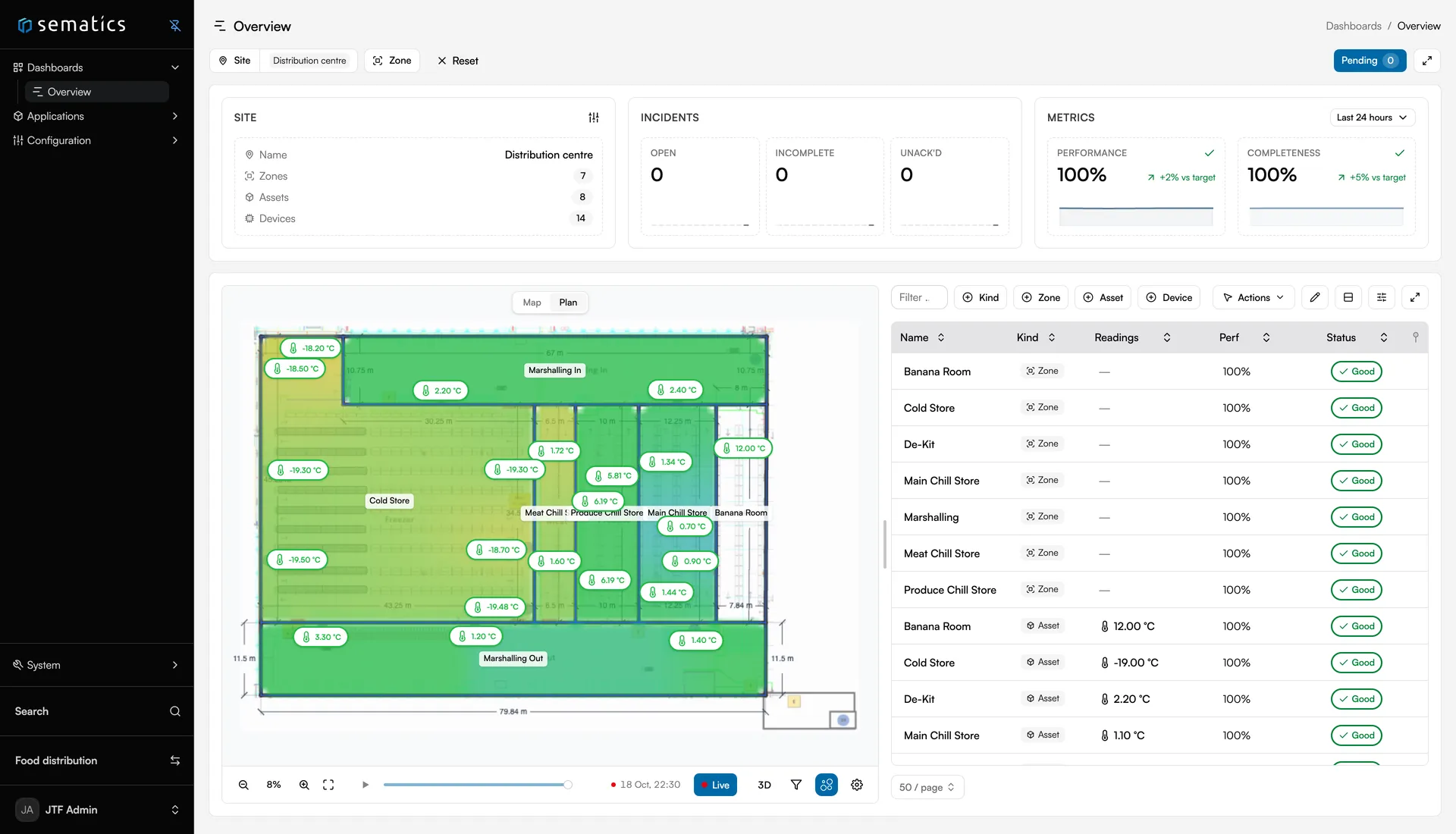
Loggers across the space show where it runs warm (by the door, under the roof) and cool (by the cooler). Monitoring goes at those extremes.
- ProtocolAreas, loading, duration and seasons agreed in writing
- StudyLoggers placed and left to run
- ReportHot and cold spots, with the evidence
- Probe positionsMonitoring placed at the extremes
- Re-mapAfter changes, or as your risk assessment sets
What's included
The whole study, run for you
We plan it, run it, report it and tell you where the monitoring should go.
A written protocol
The areas, the loading, the logger positions, how long it runs and the acceptance limits, agreed with you and signed before we start.
The study itself
Loggers placed across the space under representative conditions, including door openings and normal working.
A report you can hand over
The data analysed, the hot and cold spots identified, any areas that don't hold their limits, and the conclusions in plain words.
Probe positions
Recommended monitoring points taken from the results, so you can show the inspector why each probe is where it is.
Re-mapping
A repeat study after new racking, a new cooler, a changed door or layout, or on the interval your risk assessment sets.
Seasonal studies
Summer and winter studies where seasonal heat or cold could push the space out of range.
How it works
From protocol to monitoring in four steps
- 01
Plan it with you
We look at what you store, the space and your last study (if you have one), then agree the protocol in writing.
- 02
Run the study
Our team places the loggers, runs the study for the agreed period and collects them.
- 03
Report it
You get the report, the hot and cold spots and the recommended probe positions.
- 04
Monitor where it matters
If you choose, we fit JTF monitoring at those points, with sensors calibrated in our UKAS accredited calibration laboratory No. 10723.
What it covers
The spaces we map
Any space where medicines, samples or food are stored to a temperature limit.
| Space | Why it's mapped | When to map again |
|---|---|---|
| Ambient warehouses | Large spaces vary by height, by roof and wall, and near loading doors | After racking or layout changes, for seasonal extremes, and at least every three years by default |
| Cold rooms and chillers | Airflow from the cooler and door openings create warm and cold zones | After a new cooler, a changed door or a change in use, and at least every three years by default |
| Freezer rooms | Ice build-up and door traffic shift where the extremes sit | After equipment changes, and at least every three years by default |
| Pharmaceutical fridges | The door, shelves and fan position mean one probe point is not the whole fridge | At least 48 hours of multi-point logging after any move, repair or set-point change |
Mapping is a JTF managed service, carried out in line with GDP 3.2.1 and recognised guidance (WHO TRS 961 Annex 9 Supplement 8, ISPE) and the protocol we agree with you. Our UKAS accreditation (UKAS accredited calibration laboratory No. 10723) covers temperature calibration, not mapping.
Which rules it serves
What your inspector or auditor will look for
MHRA GDP
Initial mapping before use, re-mapping after significant changes, monitoring at the mapped extremes.
Read the guideBRCGS
Evidence that stores hold their temperature across the whole space.
Read the guideTemperature excursions
What to do when a reading goes out of range, and how mapping helps you judge the impact.
Read the guide
Questions
What people ask us
Is the mapping UKAS-accredited?
No. Our UKAS accreditation (UKAS accredited calibration laboratory No. 10723) covers temperature calibration. Mapping is carried out in line with GDP 3.2.1 and recognised guidance (WHO TRS 961 Annex 9 Supplement 8, ISPE), to the protocol we agree with you.
How long does a study take?
It depends on the size of the space and what your risk assessment asks for. We agree the duration in the protocol, before we start.
Do we need summer and winter studies?
If seasonal heat or cold could push the space out of range, usually yes. We'll tell you which applies to you on the call.
When do we need to map again?
GDP asks for re-mapping after significant changes, such as new racking, a new cooler or a changed door, or on the interval your risk assessment sets. We can book repeat studies with you.
Our monitoring went in before the mapping. Can you justify the probe positions?
Yes. We cross-reference your installed probes to the mapping, mark which cover the mapped hot and cold spots, and write the probe rationale with you, including retrospective ones. Your RP or QA approves it. See how to justify probe locations.
Do we have to use JTF monitoring afterwards?
No. The report and probe positions are yours.
What happens in the 20-minute check?
We ask what you store, what your last study covered (if you have one) and what an inspector would expect next. You leave knowing the scope.
Next step
Plan your mapping study
Tell us the spaces, what you store and what your last study covered. We'll scope the protocol, the duration and whether you need summer and winter studies.