Almost every vaccine must be kept at +2 °C to +8 °C from delivery to the moment it is given, and you have to be able to show that it was. This page walks through where that expectation comes from, what a sound daily and yearly routine looks like, and what to do when a reading is out of range. The one thing to remember: when something goes wrong, quarantine the stock in the cold, do not throw anything away, and get advice before you decide.
Why it matters
You cannot see a damaged vaccine
Vaccines are biological products, and heat or cold can weaken them without changing how they look. UKHSA's incident guidance explains that most UK vaccines tolerate short excursions and that loss of potency is gradual, but freezing is different: it can denature proteins, break the bond between the aluminium adjuvant and the antigen, and crack vials. A vaccine known to have been below 0 °C should be disposed of. The patient risk is a dose that gives less protection than everyone believes, and if compromised doses have already been given, the provider may have to consider telling patients and offering revaccination.
There is also a cost, and it falls on you. The Green Book chapter 3 notes that distributors and manufacturers will not take vaccines back once they have left their control, so any stock lost to a fridge failure is your loss. UKHSA's Vaccine Update 369 reported £6.4 million of vaccine wastage in 2025, of which 84% was avoidable.
What the rules say
The licence, the Green Book, and the people who check
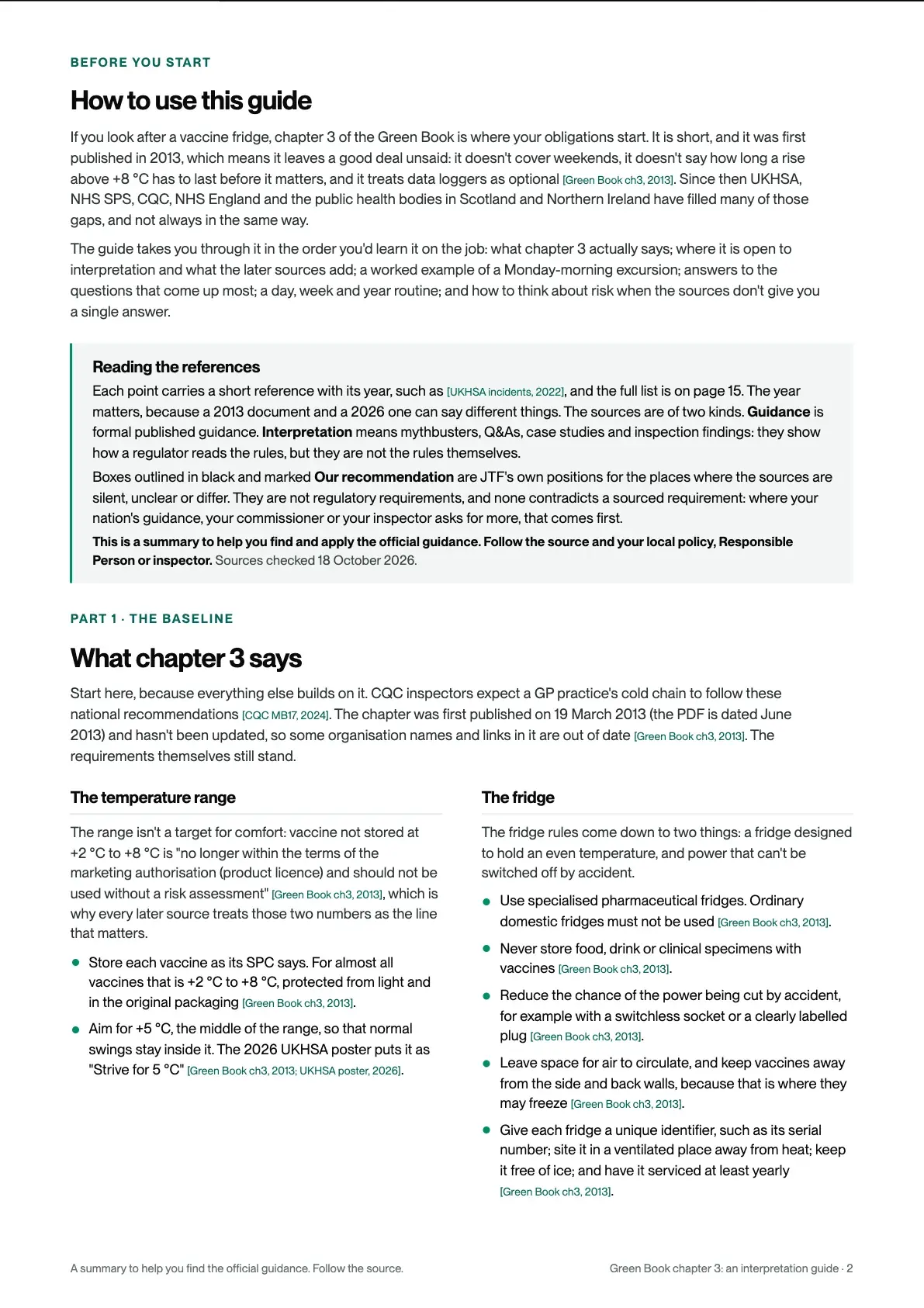
The starting point is the product licence. Each vaccine's SPC sets its storage conditions, which for almost all vaccines is +2 °C to +8 °C, protected from light and in the original packaging. The Green Book says good practice is to aim for +5 °C, the middle of the range, which UKHSA's Keep your vaccines healthy poster shortens to "Strive for 5°C". The Green Book and the 2014 protocol also say that vaccine not stored at +2 °C to +8 °C is no longer a licensed product, which is why an excursion turns into a clinical decision rather than a housekeeping note.
The detail sits in formal guidance rather than statute. Green Book chapter 3 sets the core expectations: a specialised pharmaceutical fridge, never a domestic one; at least one max/min thermometer independent of mains power alongside the built-in display; readings at least once each working day, signed; annual calibration and servicing; records kept for at least a year and covering the full storage history. The 2014 protocol for ordering, storing and handling vaccines adds routine weekly, monthly and quarterly checks, and the 2022 incident guidance sets out what to do when things go wrong.
Who enforces it, and where the nations differ
In England, incidents are reported first to the local NHS England screening and immunisation team (SIT). Inspection depends on the setting: SPS's local policy guidance names the CQC for GP practices, hospitals and care homes and the GPhC for registered pharmacies. CQC's GP mythbuster 17 restates the Green Book and tells you what inspectors will look at, so read it as CQC's interpretation of the national guidance.
Scotland and Northern Ireland publish their own guidance on the same foundation, and both go further in places. Public Health Scotland recommends readings twice daily, at the start and end of the working session. The Northern Ireland PHA says at least daily and preferably twice, with a data logger as back-up set to 5-minute intervals and reviewed weekly. If you work across nations, treat the guidance for each site's nation as the floor.
What good looks like
The fridge itself
Good practice starts before the first reading. Use a pharmaceutical fridge, sited in a ventilated place away from heat, with a unique identifier such as its serial number. Protect it from being switched off by accident: the Green Book accepts a switchless socket or a clearly labelled plug, while the 2014 protocol says fridges must be wired into switchless sockets. Keep it for vaccines and medicines only, never food, drink or specimens.
Load it so air can move. The Green Book asks for space around packages and for vaccines to be kept away from the side and back walls, where they may freeze, and the UKHSA poster adds: do not overfill, keep vaccines in their original packaging in the main part of the fridge rather than drawers, and put the shortest-dated stock at the front. Hold no more than two to four weeks' supply, as the Green Book says, so that a failure costs less. Have a written plan for back-up storage before you ever need it.
A day, a week, a month, a year
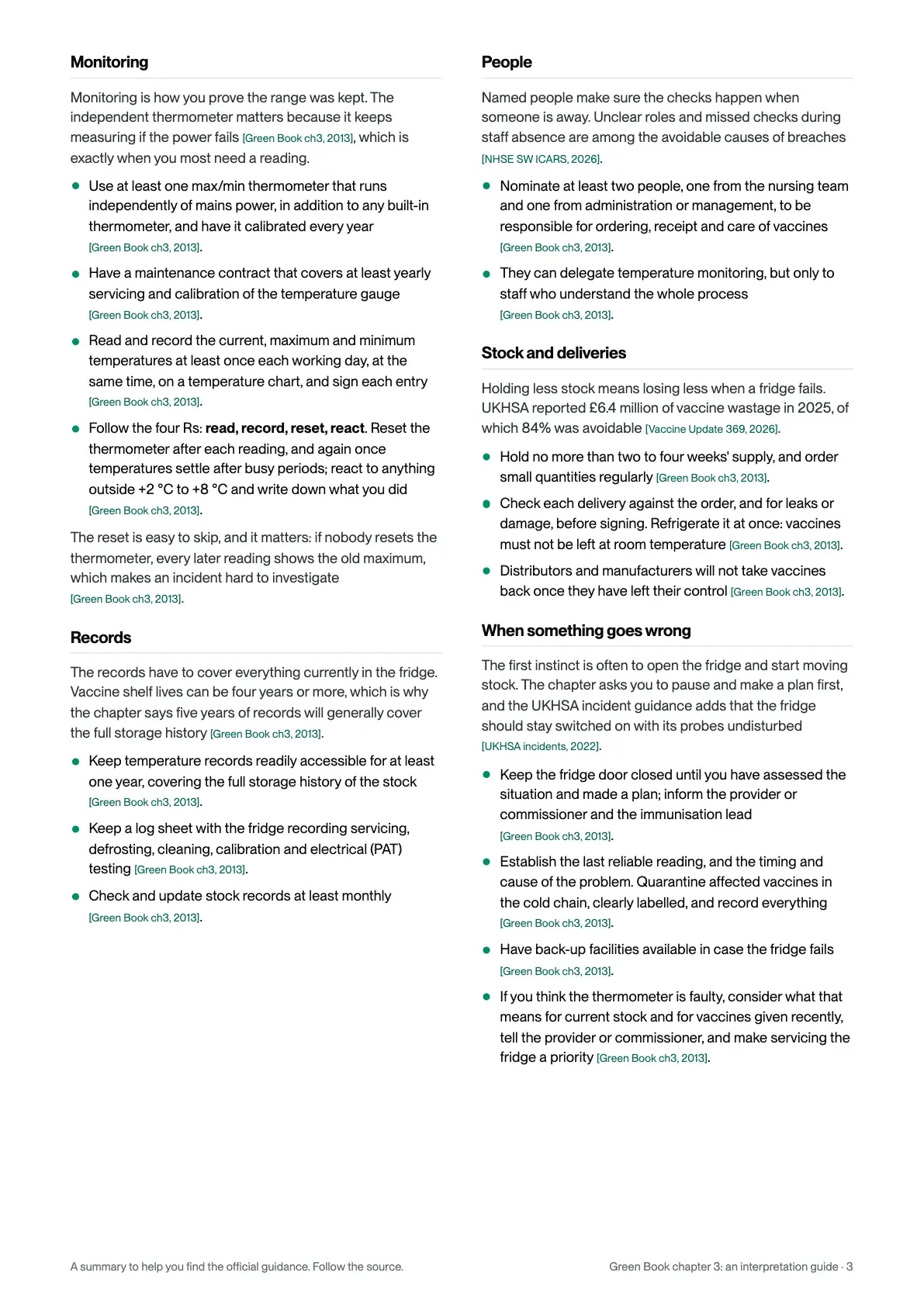
The daily routine is the Green Book's four Rs. Read the current, maximum and minimum temperatures at the same time each working day. Record them on a standard chart and sign the entry. Reset the max/min thermometer after each reading, and again once temperatures settle after busy periods. React if anything is outside +2 °C to +8 °C, and write down what you did.
Around the daily check sits a slower cycle. The 2014 protocol asks for weekly checks of fridge contents for rotation and expiry, monthly stock audits and a monthly check of the fridge reading against an independently powered thermometer, and a quarterly vaccine management review. Once a year, the fridge is serviced and the temperature gauge and independent thermometer are calibrated, with servicing, defrosting, cleaning, calibration and PAT records kept on a log sheet with the fridge.
Worked example
Monday 08:30: the max reads 11.2 °C
This is an illustrative example. The fridge was read and reset at 17:30 on Friday. On Monday at 08:30 the thermometer shows current 5.1 °C, minimum 4.0 °C and maximum 11.2 °C. The fridge is back in range, but at some point over the weekend it reached 11.2 °C, and the reading alone cannot tell you when or for how long.
That matters because UKHSA's reassuring allowance does not apply. UKHSA says a one-off rise above +8 °C lasting less than 20 minutes, such as during restocking, needs no further action, but only if you know it was a one-off and under 20 minutes, with the vaccines in their original packaging and stored properly before. The rounding allowance does not help either: some manufacturers accept readings up to +8.4 °C as +8 °C, and 11.2 °C is well outside that. Without other evidence, SPS's excursion guidance says to assume the excursion started just after the last reset, which here means up to 63 hours.
So you work through the incident steps in order, and you write down each one as you go: the readings, the times, who did what, and who you spoke to.
- 08:30Fix the obviousCheck the door, the plug and the power. Keep the door shut and check the probe is placed correctly.
- 08:35Quarantine in the coldLabel the stock 'not for use' and keep it at +2 °C to +8 °C, moving it to another monitored fridge if needed.
- 08:40Leave the evidence aloneLeave the fridge switched on with probes undisturbed. Download any data logger to see the real duration.
- 08:45Inventory and checklistList products, batch numbers and quantities. Complete the UKHSA incident checklist.
- 09:15Report and get adviceCall the screening and immunisation team. Seek manufacturer stability advice. Discard nothing yet.
- LaterDecide and recordRecord the risk assessment, who advised and who decided. Get the fridge checked by an engineer.
An illustrative sequence drawn from the UKHSA vaccine incident guidance and SPS's excursion steps.
Where it is unclear
Where the sources disagree
Several questions have more than one official answer. How often to read the fridge depends on the nation: see once or twice a day. UKHSA's 20-minute allowance depends on knowing how long an excursion lasted, which a max/min thermometer cannot show: see UKHSA's 20-minute allowance. Low readings are treated differently too. UKHSA says a minimum between 0 °C and +2 °C is unlikely to have affected vaccines, while SPS calls any reading below 2 °C potentially significant and the SW ICARS toolkit treats it as reportable: see readings between 0 and 2 °C.
Records raise two more. CQC expects the daily manual reading even with a logger fitted, while SPS points to continuous monitoring with remote alerts for closed periods: see logger versus daily reading. Calibration guidance ranges from "annually" to multi-point calibration by an accredited service: see calibration frequency. In each case, identify which guidance applies to your setting, assess the risk to your stock, and record your reasoning in your cold chain policy.
In summary
The short version
- Store vaccines at +2 °C to +8 °C, aiming for +5 °C, in a pharmaceutical fridge used for vaccines and medicines only.
- Fit an independent max/min thermometer alongside the built-in display, and protect the plug from being switched off.
- Read, record, reset and react at least once each working day, more often if your nation's guidance asks.
- Check contents weekly, audit stock monthly, review quarterly, and service and calibrate yearly.
- Hold no more than two to four weeks' stock and have a written back-up storage plan.
- After an excursion, quarantine in the cold, leave the fridge undisturbed, report to the SIT and discard nothing until advised.
- Record the duration evidence, the advice you received and who made the decision.
- Keep records for at least a year and for the full storage history of the stock; five years generally covers it.