Data integrity means your temperature records are complete, consistent and accurate, and stay that way from the moment they are made until they are archived. Inspectors don't just want to see data: they want to know it can be trusted.
For many pharma organisations it is still one of the most overlooked risks in compliance. A fridge can be perfectly controlled and still produce a finding if the record of it has gaps, unexplained edits or no trace of who did what. This article explains the principles, where integrity breaks down in monitoring, and how to fix it.
What data integrity means: ALCOA+
The MHRA's data integrity guidance, and regulators generally, use the ALCOA+ principles. Here is what each one means for a temperature record.
| Principle | What it means for a temperature record |
|---|---|
| Attributable | You can see who or what made each entry: the sensor for a reading, the named user for an acknowledgement or comment. |
| Legible | Readable and understandable, now and in years to come. |
| Contemporaneous | Recorded when it happened, not written up at the end of the shift. |
| Original | The first record, or a true copy of it, is kept. |
| Accurate | Correct, from a calibrated sensor, with no unexplained changes. |
| Complete | No missing readings, or gaps explained. |
| Consistent | Same format, time base and units across units and sites. |
| Enduring | Kept for the full retention period on durable storage. |
| Available | Can be produced promptly when an inspector asks. |
Where data integrity breaks down
Most problems come from fragmented or semi-manual systems, each with its own point of failure.
Manual data entry
Handwritten logs and manual transcription bring human error, missing entries and late recording. A column of identical readings in the same handwriting is the classic sign of a record filled in after the fact, and inspectors know it.
Disconnected systems
When monitoring, alarms and deviation tracking sit in separate places, data is hard to reconcile, audit trails have gaps and investigations take longer. An alarm in one system and a deviation form in another, with no link between them, leaves the inspector to join the dots.
No real-time visibility
If an issue is only found at the next check, the deviation may already be hours old, the response is late and the record of what happened is incomplete.
Weak audit trails
Without a clear record of who changed an alarm limit, who acknowledged an alarm and when, it is hard to demonstrate control. For an inspector, that is a major red flag.
| Control | Paper log | Spreadsheet | Automated monitoring with audit trail |
|---|---|---|---|
| Attributable | · | · | ✓ |
| Contemporaneous | · | · | ✓ |
| Original | ✓ | · | ✓ |
| Complete | · | · | ✓ |
| Changes traceable | · | · | ✓ |
What each method can show without extra controls. Accuracy still depends on calibration in every case.
Why it matters more than ever
Regulators have sharpened their focus on electronic records and signatures, system validation, data governance and audit trail review. For computerised systems in GMP, Annex 11 sets out what is expected. In an MHRA inspection, data integrity failures can be graded as major or critical deficiencies, and serious ones can lead to regulatory action against a licence.
Put simply: if your data isn't trusted, your processes aren't either.
How to fix it
The most effective fix is to remove the conditions that cause the problems: paper, manual steps and disconnected tools. A validated, centralised monitoring platform gives you:
- Automated capture: readings recorded by the sensor at a set interval, with no transcription.
- Time-stamped records: each reading carries its time, date and source sensor.
- A complete audit trail: alarm acknowledgements, comments, limit changes and deviation closures recorded against a named user.
- Controlled access: user roles, so only authorised people can change settings, and every change is logged.
- One place for evidence: temperature data, alarms, corrective actions and calibration certificates held together and produced on request.
How JTF helps
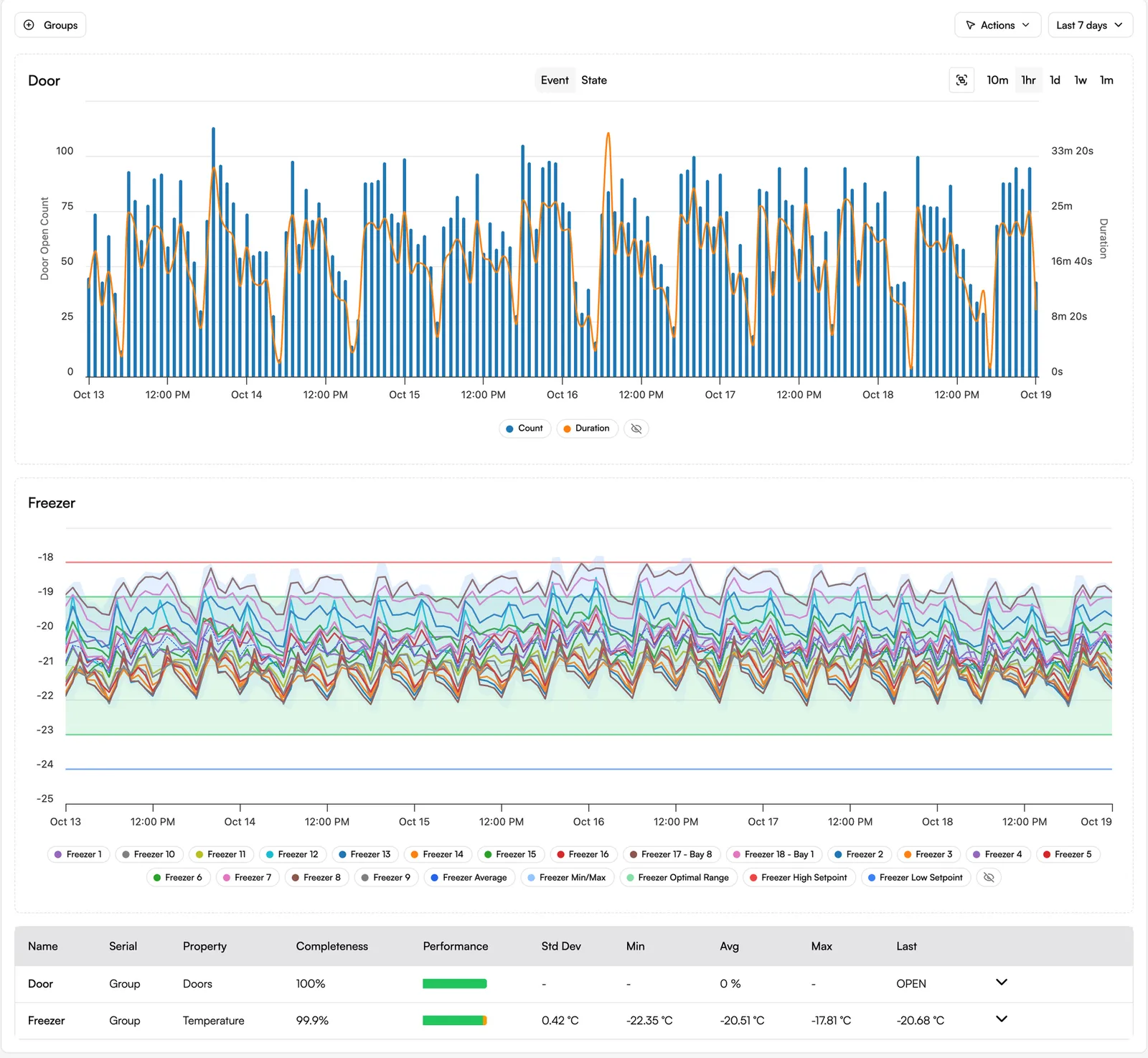
The Sematics platform processes 11 million+ temperature readings a day. JTF installs and supports it at 350+ UK sites, so readings are captured automatically, alarms are tracked with a full audit trail, and deviations follow one workflow across every site. The validation evidence for your computerised system is covered by our validation service.
Data integrity is no longer a back-office concern. It is the foundation of what you show the inspector. For the multi-site picture, see what MHRA inspectors expect from multi-site operations.
Questions people ask
What is ALCOA+?
A set of principles for trustworthy records: attributable, legible, contemporaneous, original and accurate, plus complete, consistent, enduring and available. Regulators, including the MHRA, use them to judge data integrity.
Are paper temperature logs still acceptable?
They can be, if they are completed at the time, attributable, complete and kept securely. The risk is that paper makes gaps and after-the-fact entries easy and hard to detect, especially across many units.
What should an audit trail in a monitoring system record?
Who did what and when: alarm acknowledgements, comments, changes to alarm limits or sensor settings, and deviation closures. The original reading should never be overwritten.
How does calibration support data integrity?
Accuracy is one of the ALCOA+ principles, and it depends on calibrated sensors. JTF provides calibration for every sensor we supply: traceable to national standards as standard, or UKAS accredited where you need it (temperature in our own UKAS accredited calibration laboratory No. 10723, accredited to ISO/IEC 17025; other parameters through accredited partners).
Sources
- MHRA: Good manufacturing practice and good distribution practice (GOV.UK)
- EU Guidelines on Good Distribution Practice of medicinal products for human use (2013/C 343/01), applied in Great Britain by the MHRA
- EudraLex Volume 4, Annex 11: Computerised Systems
- UKAS schedule of accreditation 10723 (JTF Wireless Ltd, calibration)