MHRA inspectors assess a multi-site operation as one quality system. If you hold a wholesale dealer's authorisation (WDA), they expect every site to store medicines within their labelled conditions, record those conditions the same way and handle deviations through the same procedure, with the Responsible Person able to show it.
Each extra site adds its own team, its own habits and its own paperwork. During an inspection those differences become very visible. This article sets out what inspectors look for across sites, where the gaps usually appear, and how a single monitoring platform helps you evidence control. For the rules themselves, see our MHRA GDP page.
What GDP actually asks for
Good Distribution Practice, applied in Great Britain by the MHRA, does not set one monitoring method. It expects you to show that storage conditions are controlled and recorded. In practice that means:
- storage areas mapped before use, with monitoring equipment placed according to the results;
- temperature monitored and recorded, with records kept and reviewed;
- monitoring equipment calibrated or checked at defined intervals;
- alarms that warn when conditions go out of range, and a defined response;
- deviations investigated, with corrective and preventive action (CAPA);
- computerised systems validated, with access controlled and an audit trail of changes.
Where multi-site operations fall short
As operations grow, consistency is the first thing to slip. Typical findings start with differences like these:
- Different sites using different record formats, or different systems entirely.
- Documentation quality that varies by site manager.
- Deviations closed quickly at one site and left open for weeks at another.
- A head office that cannot see a site's data without asking for it.
- Sensors at one site overdue for calibration because the reminders lived in someone's diary.
What inspectors expect to see
Consistent, trustworthy data at every site
Records should be accurate, complete, time-stamped and protected from unrecorded change, with no ambiguity between sites. Inspectors judge this against data integrity principles (ALCOA+). We cover those in data integrity in pharma monitoring.
Deviations managed the same way
Excursions will happen. Inspectors look at whether they are captured when they happen, how quickly they are reviewed, whether CAPA follows, and whether every site handles them the same way. A lack of standardisation here is often a red flag.
- 14:05Alarm raisedCold room at site B passes its upper alarm limit.
- 14:09Site acknowledgesSite staff acknowledge, check the door and record the action.
- 14:20Quality notifiedQuality and the Responsible Person see the event on the central dashboard.
- Next dayDeviation assessedDuration and peak reviewed against product data; stock decision recorded.
- Within your procedure's deadlineCAPA closedCause fixed, effectiveness checked, record signed off.
Illustrative times. The same steps, owners and record at every location are what make a multi-site system defensible.
A full audit trail
Every action should be traceable: who did it, when, and what changed. That includes alarm acknowledgements, changes to alarm limits and edits to comments. The trail should be easy to produce and look the same for every site.
Evidence of controlled conditions
Inspectors want proof that the monitoring works: sensors placed where mapping says the risk is, calibrated, alarms tested and reaching a person, and excursions acted on promptly. Across many sites this is hard to show without one approach.
How centralised monitoring helps
Moving from site-by-site systems to one cloud platform gives the quality team and the Responsible Person the same view of every location.
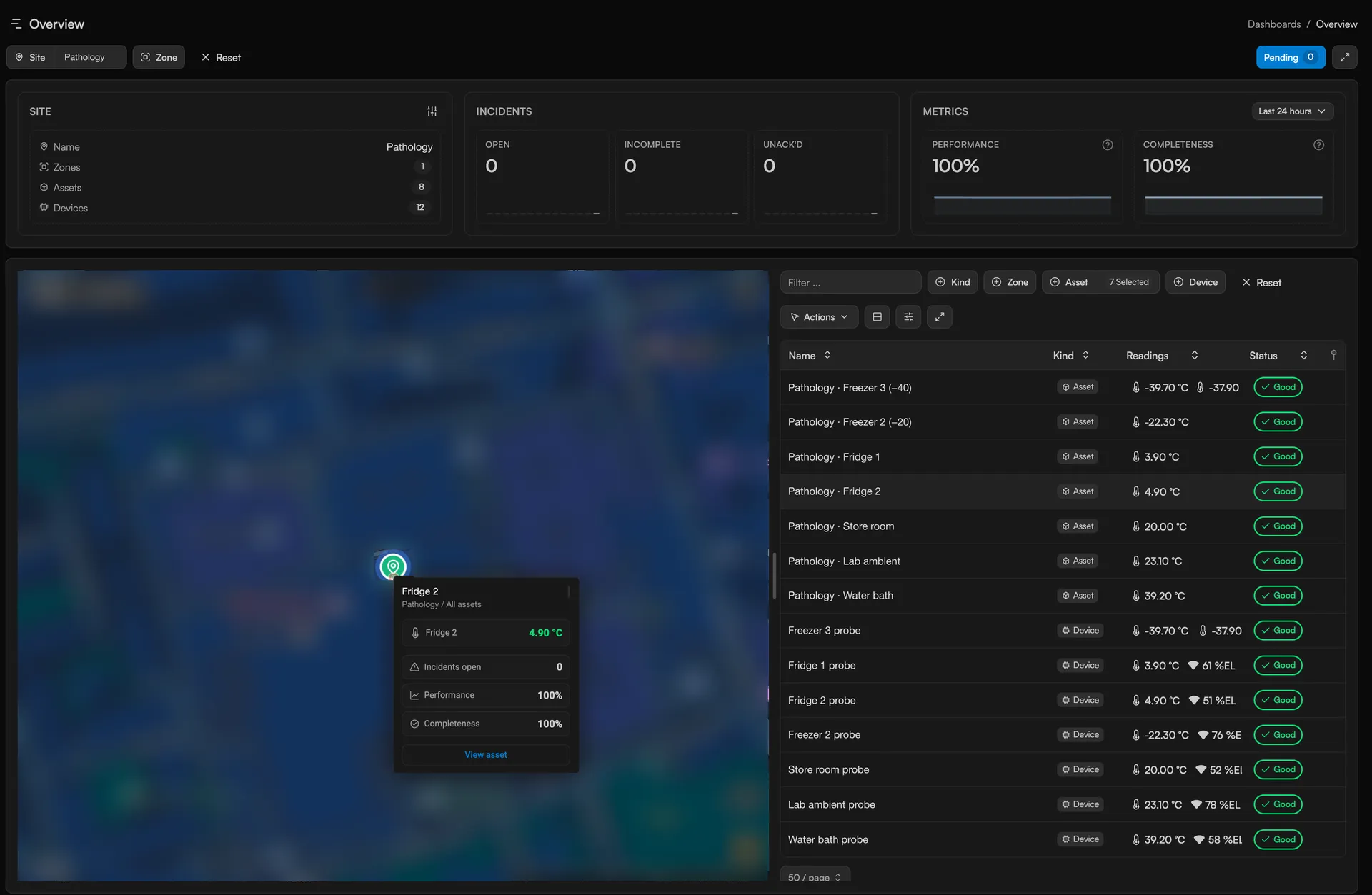
- Visibility: conditions at every site in one place, without waiting for site reports.
- One procedure: the same alarm limits, escalation rules and deviation workflow at every site.
- Faster response: alarms that escalate by SMS, phone call, email or app until someone acknowledges.
- Calibration in view: due dates and certificates held against each sensor, so nothing slips at one site.
- Inspection evidence: temperature histories, alarm records, corrective actions and sign-offs produced from one system.
Wholesalers and distributors use this across warehouses, pharmacies and vehicles. See pharmaceutical distribution for how it fits a WDA operation.
How JTF supports multi-site compliance
JTF installs, supports and calibrates monitoring through the Sematics platform at 350+ UK sites. We provide calibration for every sensor we supply: traceable to national standards as standard, or UKAS accredited where you need it (temperature in our own UKAS accredited calibration laboratory No. 10723, accredited to ISO/IEC 17025; other parameters through accredited partners). We also run temperature mapping studies as a managed service, so sensors go where the risk is.
Monitoring does not make you compliant on its own. Your procedures, training and Responsible Person oversight do that. What monitoring gives you is the evidence, the same at every site, ready when the inspector asks.
Questions people ask
Does the MHRA require continuous temperature monitoring?
GDP does not prescribe a method. It requires storage conditions to be controlled, monitored and recorded, with alarms and investigated deviations. Continuous automated monitoring is a common way to evidence that across many units and sites.
What does the Responsible Person need to see across sites?
Enough to be satisfied that every site operates to the same procedures: current temperature records, open deviations and CAPA, calibration status and any changes to the system. A central dashboard gives that view without chasing each site.
How is calibration handled across several sites?
Each sensor carries its own calibration record and due date. JTF calibrates temperature sensors in our UKAS accredited calibration laboratory No. 10723 (accredited to ISO/IEC 17025) or on site, and other parameters through accredited partners, with certificates held against the sensor in Sematics.
Do we need temperature mapping at every site?
GDP expects storage areas to be mapped before use and after significant changes, so each site's storage needs its own study. JTF runs mapping as a managed service.
Sources
- EU Guidelines on Good Distribution Practice of medicinal products for human use (2013/C 343/01), applied in Great Britain by the MHRA
- MHRA: Good manufacturing practice and good distribution practice (GOV.UK)
- The Human Medicines Regulations 2012, regulation 43 (wholesale dealer licence holders)
- EudraLex Volume 4, Annex 11: Computerised Systems