The right monitoring hardware is the device that measures the right thing, in the right place, with a calibration certificate your inspector or auditor will accept, and that keeps reporting for years without attention. For fixed sites that usually means LoRaWAN sensors and gateways; for vehicles and moving assets, cellular trackers with Bluetooth sensors in the load space.
Get the hardware wrong and no platform can rescue the record: a sensor in the wrong spot, out of calibration or out of radio range produces data you cannot defend. There are 27 device types in use on the Sematics platform; this guide explains how we choose between them, for operations, quality and logistics teams in healthcare, pharmaceutical distribution, labs and food.
Seven questions to answer first
- Temperature range. Ambient, chilled (2 to 8 °C), frozen, ultra-low (−80 °C and below), or warm assets such as incubators and ovens?
- What else to measure. Humidity, door openings, CO₂, pressure, or location?
- Environment. Clean room, hospital ward, cold store, outdoor yard, vehicle?
- Evidence required. Which standard or regulator applies, and does it expect accredited calibration with a certificate and uncertainty?
- Connectivity. LoRaWAN for buildings, cellular for vehicles, Bluetooth for sensors paired with a tracker.
- Power. Battery, mains or vehicle supply, and who will change batteries?
- Scale. How many monitoring points, across how many sites and vehicles, and do they need to sit on one dashboard?
On evidence: we provide calibration for every sensor we supply: traceable to national standards as standard, or UKAS accredited where you need it (temperature in our own UKAS accredited calibration laboratory No. 10723, accredited to ISO/IEC 17025; other parameters through accredited partners). Certificates are stored against each sensor on the platform. See calibration and ISO 17025.
Fixed sites: Node+ sensors
Fixed monitoring covers fridges, freezers, cold rooms, warm rooms, incubators, ovens, clean rooms and stores. The Node+ range shares one sealed IP67 enclosure, one LoRaWAN radio (around 1 km in buildings) and two AA lithium cells (up to 4 years at 5-minute logging). Models differ in what they connect to.
| Model | What it measures | Typical use |
|---|---|---|
| Node+ Embedded (SEN-AIN) | Internal temperature, −40 °C to +85 °C, ±0.1 °C; no external inputs, fully sealed | Fridges, freezers, ambient stores, warm rooms |
| Node+ PT100 (SEN-BEP) | 4-wire PT100 probe, −200 °C to +200 °C, ±0.1 °C typical; internal sensor; door input | Ultra-low freezers, tanks, medical and blood fridges |
| Node+ Digital (SEN-CED) | External digital temperature and humidity probe; internal sensor; door input | Pharmacy stores, labs, ambient rooms |
| Node+ Analog (SEN-AEA) | Third-party 4 to 20 mA, 0 to 5 V or 0 to 10 V sensors; internal sensor; door input | CO₂ incubators, pressure rooms, gas |
| Node+ IO (SEN-AED) | Door contact only, open and close timestamped with duration | Cold-room, cabinet and fridge doors |
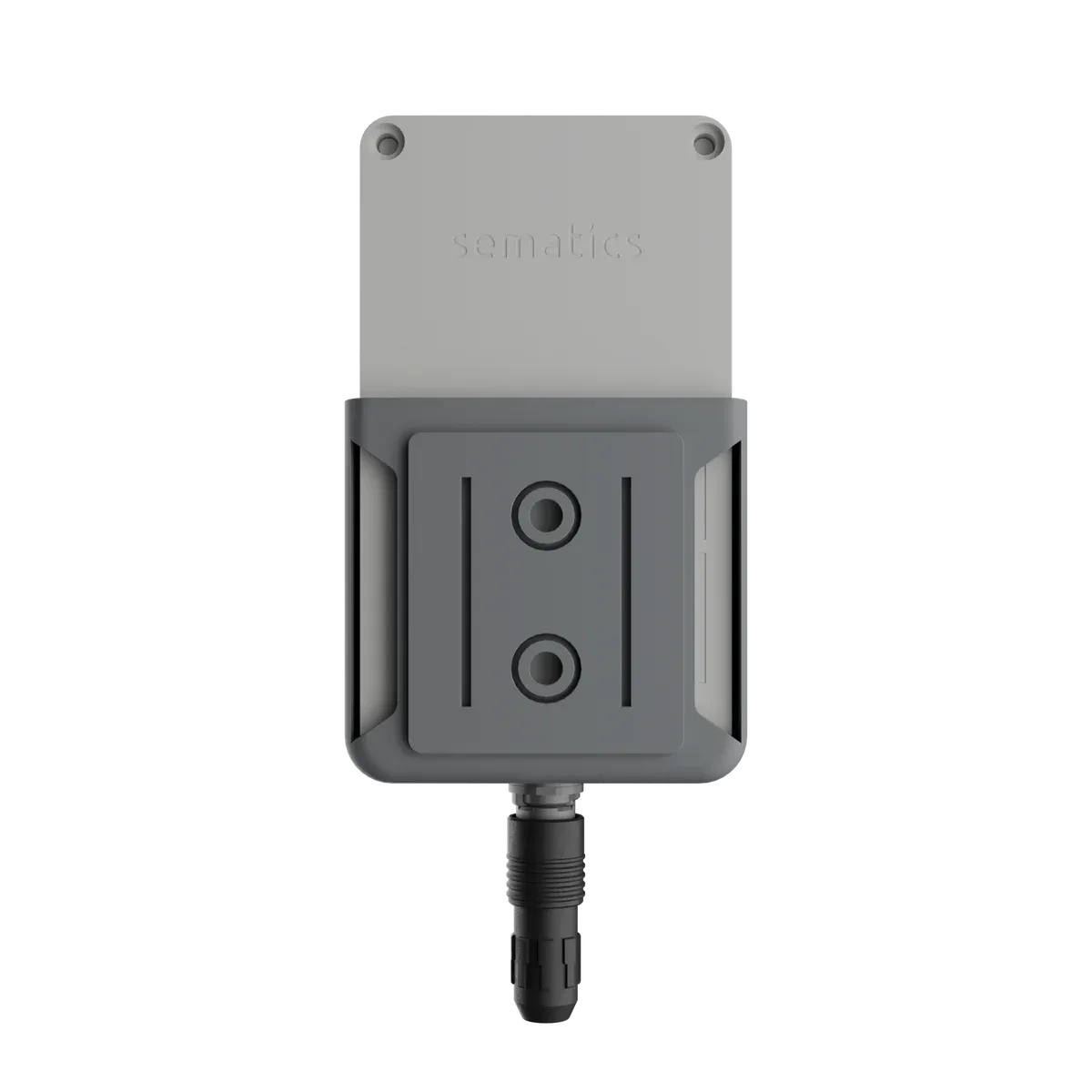
A buffered probe follows the temperature of the product rather than the air, which swings each time the door opens. Whether you need one depends on your procedure and what you are storing; we advise on this at survey. The full Node+ specs are in Node+ sensor specs at a glance.
Gateways: Link+
Gateways receive readings from sensors and send them to the cloud. Each Link+ gateway handles up to 2,000 devices (the 16-channel Link+ Pro, up to 4,000) and uses its own Ethernet or 4G connection, so it does not need access to your clinical or office network.
| Gateway | Where it goes | Backhaul and rating |
|---|---|---|
| Link+ One (GW-ONE) | Indoors: wards, labs, shops, offices | Ethernet (PoE) with built-in 4G backup; indoor only, −10 °C to +55 °C |
| Link+ Core (GW-CORE) | Outbuildings, small cold rooms, edge zones | 4G LTE; IP65 for light outdoor use under shelter, −30 °C to +55 °C |
| Link+ Pro (GW-PRO) | Warehouses, yards, remote sites | Ethernet with 4G failover; IP67, −40 °C to +70 °C; optional battery backup |
How many gateways a site needs depends on its walls, floors and racking more than its floor area, which is why we survey before we quote. More on the radio in why we use LoRaWAN.
Fleets and moving assets: trackers and Eye sensors
Vehicles leave gateway range within minutes, so fleet monitoring uses trackers with their own cellular connection. Temperature, humidity and door status in the load space come from Eye sensors, small Bluetooth sensors that pair with the tracker so every reading carries a location.
| Device | Best for | Key features |
|---|---|---|
| Plug-and-play OBD II tracker | Vans and light vehicles, quick fit | GPS, 2G/4G; diagnostics, mileage and fuel via OBD II; Bluetooth to Eye sensors; installs with no wiring |
| Installed vehicle tracker | Refrigerated vans, HGVs and trailers | Hard-wired against tampering; ignition, door and 1-wire inputs; Bluetooth sensors; internal backup battery |
| Asset tracker | Trailers, containers, unpowered cold boxes | Own battery, up to 3 years; IP68; Bluetooth sensors; movement and tamper detection |
| Camera-enabled tracker (FMC650) | High-value or safety-critical deliveries | High-precision GNSS, 4G; up to 2 cameras; CAN; Bluetooth to Eye sensors |
| Eye sensor (SEM-BLE-Eye) | Load spaces and boxes, with any tracker | Temperature and humidity, movement, tilt and door; up to 5 years; IP67; EN 12830 variant (±0.5 °C) |
For rolling out trackers across a fleet, see the telematics implementation guide.
Matching the device to the job
| Control | Temperature | Humidity | Door | Location |
|---|---|---|---|---|
| Node+ Embedded | ✓ | · | · | · |
| Node+ PT100 | ✓ | · | ✓ | · |
| Node+ Digital | ✓ | ✓ | ✓ | · |
| Node+ IO | · | · | ✓ | · |
| Tracker with Eye sensor | ✓ | ✓ | ✓ | ✓ |
From the product files. A tick means the device measures it directly or through a paired sensor.
Common pitfalls
- Uncalibrated sensors in a regulated store. An inspector will ask for the certificate. Without one, the readings are not evidence.
- Sensors in the worst spot, not the stock's spot. A probe above the door, or where the cable happened to reach, records air the product never sees. Place sensors where the product sits; a mapping study shows where that is in larger stores.
- Gateways placed for convenience. A gateway in a comms cupboard behind two fire doors may not reach the cold room. Survey first.
- Vehicle sensors that cannot cope with the load space. Check the operating range and IP rating against a frozen trailer, not an office.
- A different system at every site. Mixed hardware and platforms make it hard to compare sites or follow a load from store to vehicle. Standardise where you can.
- Nobody owns the batteries. Plan changes with the annual calibration visit rather than waiting for a sensor to go quiet.
How we help
We survey your sites and vehicles, specify hardware for each unit, install and commission it, calibrate the sensors and support the system afterwards under a service agreement. Fixed sensors and fleet trackers report to the same Sematics platform, so one dashboard shows the cold store and the vehicle that left it. See installation and support.
Questions people ask
Which sensor should I use in a vaccine fridge?
Most vaccine fridges use a Node+ Embedded for air temperature, or a Node+ PT100 where a probe is preferred. Your procedure, and whether you want a buffered probe, decides which; we advise at survey.
Do I need a gateway at every site?
Usually yes, at least one per site, because sensors send readings to a gateway within radio range. Each gateway handles up to 2,000 devices, so most sites need only a few.
Can the same platform monitor stores and vehicles?
Yes. Node+ sensors in buildings and trackers in vehicles both report to Sematics, so stores and fleet sit on one dashboard with one audit trail.
Is the calibration accredited?
We provide calibration for every sensor we supply: traceable to national standards as standard, or UKAS accredited where you need it (temperature in our own UKAS accredited calibration laboratory No. 10723, accredited to ISO/IEC 17025; other parameters through accredited partners). Certificates are stored against each sensor.