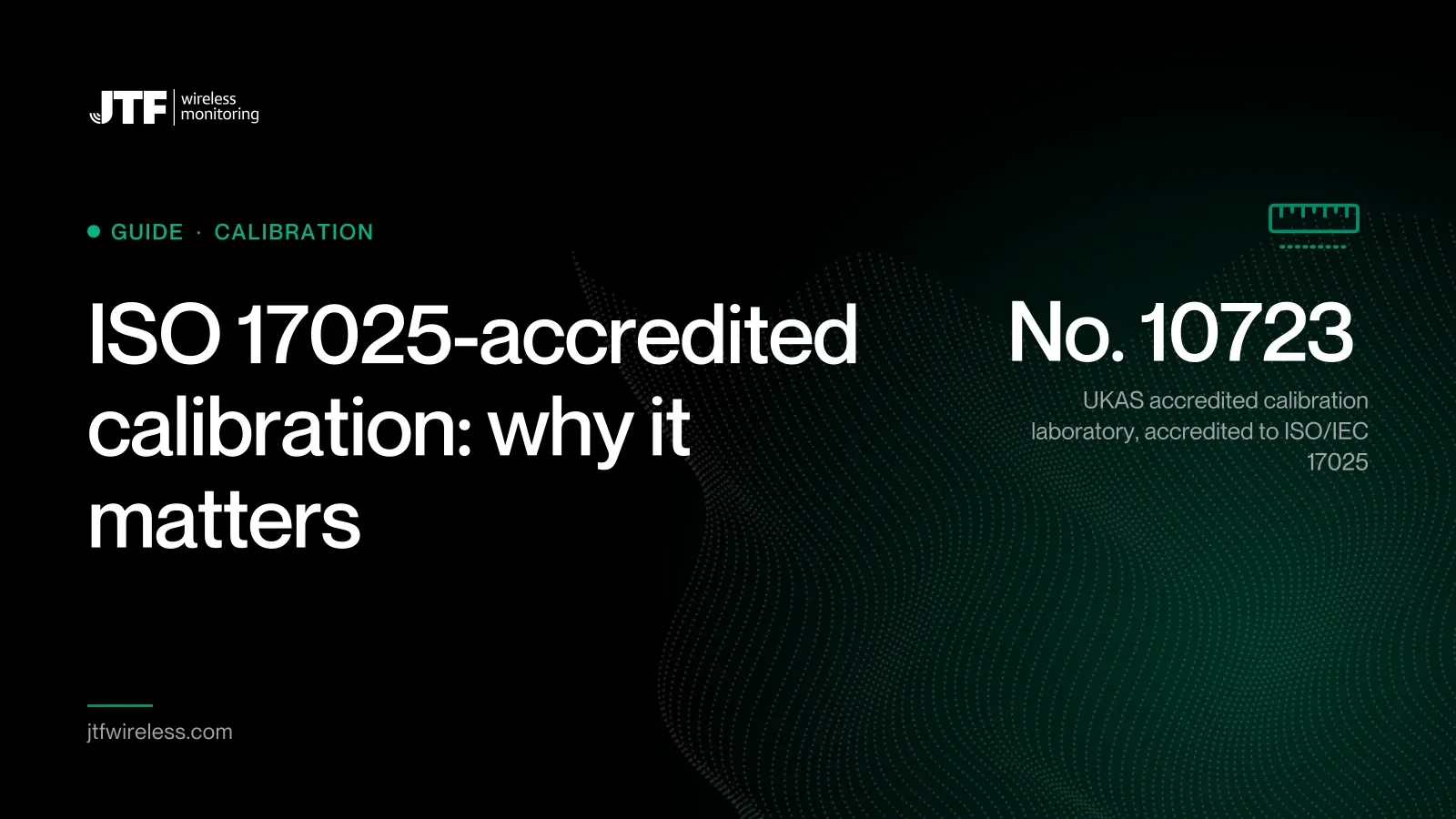
ISO/IEC 17025 is the international standard for the competence of testing and calibration laboratories. A laboratory accredited to it by UKAS has been assessed for each measurement on its schedule, so a certificate it issues inside that scope is traceable to national standards. That is the evidence MHRA inspectors, UKAS assessors and BRCGS auditors look for.
For anyone whose compliance rests on logged temperatures, that matters: the record is only as good as the sensor behind it. We provide calibration for every sensor we supply: traceable to national standards as standard, or UKAS accredited where you need it (temperature in our own UKAS accredited calibration laboratory No. 10723, accredited to ISO/IEC 17025; other parameters through accredited partners). Here is what that means and how to check it.
What ISO 17025 accreditation means
Calibration compares a sensor with a reference of known accuracy and records the difference. Accreditation goes further. It means an accreditation body has assessed the laboratory's whole system: its methods, its references and their traceability, its environment, its staff's competence and how it calculates measurement uncertainty.
Accreditation is granted for a defined scope: named measurements, over stated ranges, with a stated best uncertainty. Outside that scope the laboratory may still calibrate, but the certificate is not an accredited one. Laboratories are accredited, never certified, to ISO/IEC 17025.
| Requirement | What it means for you |
|---|---|
| Traceability | Each result links through an unbroken chain of calibrations to national or international standards. |
| Measurement uncertainty | Each result comes with its uncertainty, calculated by an assessed method, so you can apply your own decision rule. |
| Competence | Staff are trained and their competence is assessed for the methods they use. |
| Controlled conditions | Calibration is done in conditions the laboratory monitors and records. |
| Independent assessment | UKAS reassesses the laboratory regularly against the standard and its scope. |
The risks of poor or non-accredited calibration
A sensor that is not calibrated, or calibrated without traceability, can read wrong without anyone knowing. The record looks fine while the fridge, store or vehicle runs outside its limits.
- Decisions on wrong data. Stock released, or quarantined, on the strength of a reading that was off.
- False confidence. An alarm-free record that hides real excursions.
- Stock and quality failures. Product spoiled or degraded without the record showing it.
- Findings at inspection. Calibration is one of the first things an inspector or auditor checks, and a certificate with no traceability is hard to defend.
- Weaker evidence in a dispute. Data from an unverified sensor carries less weight when a load or a claim is questioned.
Who needs accredited calibration
The rules below expect monitoring equipment to be calibrated and traceable. Accredited calibration is the most direct way to show that.
| Sector | Relevant rules |
|---|---|
| Pharmaceutical distribution | MHRA, Good Distribution Practice |
| Healthcare and laboratories | ISO 15189, NHS trust quality systems, HTA |
| Food storage and distribution | BRCGS, HACCP |
| Research and diagnostics | Study and quality requirements for traceable data |
See MHRA and GDP, ISO 15189 and BRCGS for what each one expects of monitoring. Outside regulated sectors, customers increasingly ask for proof too, and calibration is a common place where standards slip.
How to check a laboratory's scope
Every UKAS-accredited laboratory has a public schedule of accreditation. Search for it on the UKAS website, then check three things:
- The measurement. Is the parameter you need (temperature, humidity, pressure) on the schedule?
- The range. Do the points you need sit inside the accredited range?
- The uncertainty. Is the best uncertainty small enough for your tolerance and decision rule?
Our own schedule, UKAS accredited calibration laboratory No. 10723, covers temperature only. The two ranges are shown below. Other parameters, such as humidity, are calibrated by accredited partners and come with their own accredited certificates.
From our schedule of accreditation. Temperature only; other parameters are calibrated by accredited partners.
UKAS is a signatory to the ILAC Mutual Recognition Arrangement, so accredited certificates are recognised by accreditation bodies in other signatory countries.
What an accredited certificate shows
An accredited certificate carries the UKAS mark and the laboratory's number, and it should give:
- the sensor's serial number, so the certificate belongs to one device;
- the readings at each calibration point, as found and, if adjusted, as left;
- the error at each point and its measurement uncertainty;
- the reference used and its traceability;
- the date of calibration and the method.
The uncertainty is what lets you apply a decision rule, such as guard banding your alarm limits. Our guide to measurement uncertainty in medical laboratories works through that with examples.
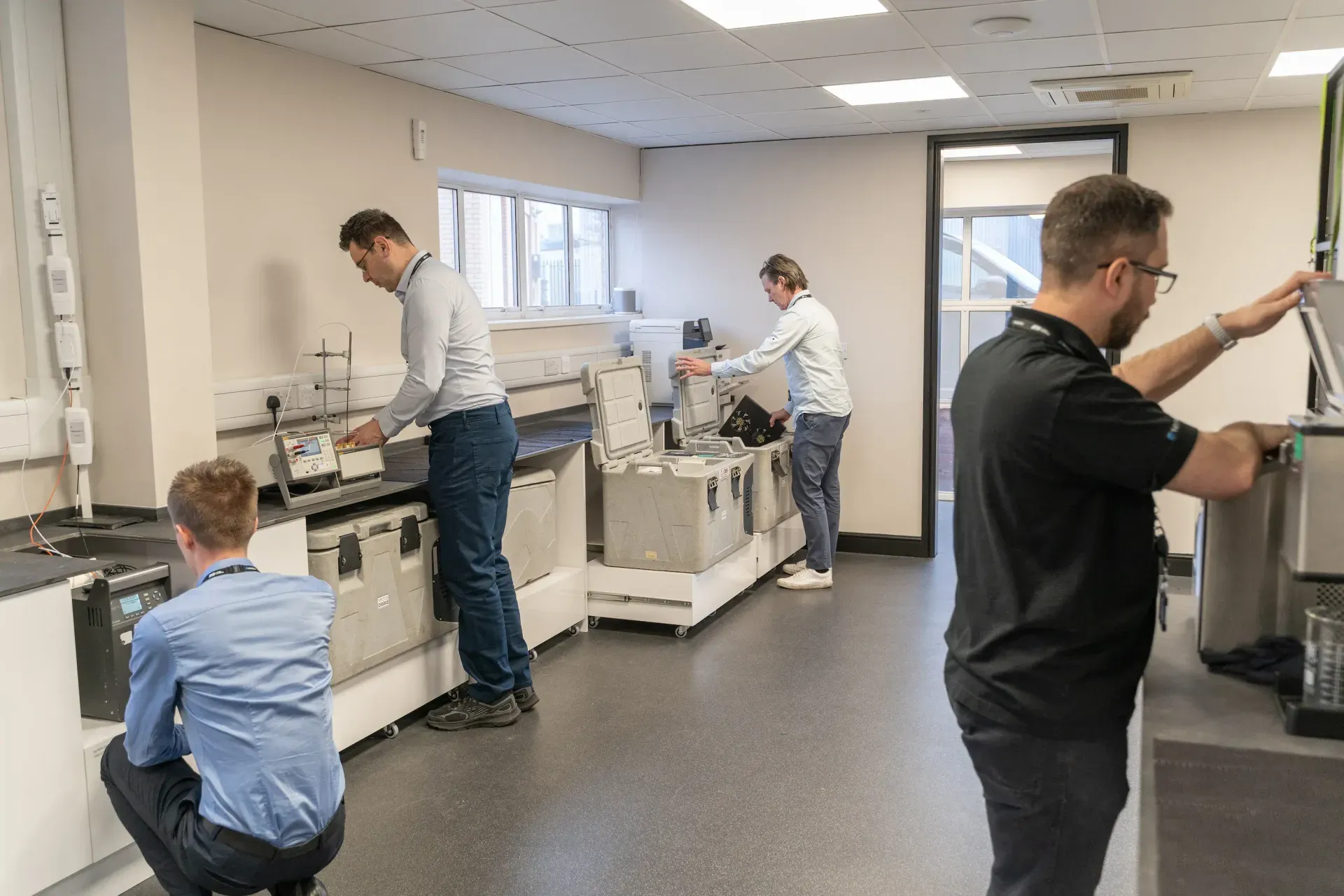
How we calibrate
We run a UKAS accredited calibration laboratory No. 10723, accredited to ISO/IEC 17025 for temperature, and work with accredited partners for other parameters. Our calibration is traceable to national standards as standard, or UKAS accredited where you need it.
10,000+
sensor calibrations a year
Sensor calibrations a year, across our own lab and accredited partners.
- Calibration for every sensor we supply: traceable to national standards as standard, or UKAS accredited where you need it (temperature in our own UKAS accredited calibration laboratory No. 10723; other parameters through accredited partners).
- Multi-point temperature checks at the points that matter for how the sensor is used.
- A certificate tied to each sensor's serial number.
- Temperature calibration in our lab or on site, so monitoring keeps running.
Every certificate is uploaded to Sematics against its sensor, where your QA or compliance team can review it, download it for an inspector, approve it in the platform, and get a reminder before it expires. Nobody has to chase paper before an audit.
In the lab or on site
Lab calibration suits sensors that can come off site for a short time. On-site temperature calibration suits fixed probes and sites that cannot lose a sensor even briefly; an engineer brings the reference to the unit and calibrates it in place.
Either way, the certificate is the same accredited certificate, inside the same scope, and it goes into Sematics against the same sensor. Plan calibration around your busiest periods and inspection dates, so certificates are never close to expiry when an inspector arrives.
What accredited calibration gives you
- Evidence that stands up when an inspector or auditor asks for it.
- Confidence that an alarm-free record means the conditions really stayed in limits.
- Measurement uncertainty you can build into alarm limits and decision rules.
- Less time spent finding and checking certificates before an audit.
Find out more about our calibration service and how calibration fits into ISO 17025.
Questions people ask
What is the difference between calibration and accredited calibration?
Any calibration compares a sensor with a reference. Accredited calibration is done by a laboratory that UKAS (or another ILAC MRA signatory) has assessed as competent for that measurement and range, so the certificate carries assessed traceability and uncertainty.
Should a calibration laboratory be certified or accredited?
Accredited. Laboratories are accredited to ISO/IEC 17025 by an accreditation body such as UKAS, for a defined scope of measurements. Certification applies to management system standards such as ISO 9001.
Is your own laboratory accredited for humidity?
No. Our accreditation, number 10723, is for temperature only. Other parameters, such as relative humidity, on the sensors we supply are calibrated through accredited partners, with their own accredited certificates.
Can you calibrate on site?
Yes, temperature calibration can be done on site or in our laboratory, depending on what keeps your monitoring running best.
How often should monitoring sensors be calibrated?
Most sites calibrate annually, but the interval is your decision and should reflect the sensor's history, how it is used and your quality system. Sematics reminds you before each certificate expires.
Sources
- ISO/IEC 17025:2017 General requirements for the competence of testing and calibration laboratories
- UKAS schedule of accreditation 10723 (JTF Wireless Ltd, calibration)
- UKAS: Calibration laboratory accreditation (ISO/IEC 17025)
- UKAS: Search accredited organisations and their schedules
- ILAC: Mutual Recognition Arrangement and signatories
- EU Guidelines on Good Distribution Practice of medicinal products for human use (2013/C 343/01), applied in Great Britain by the MHRA
- ISO 15189:2022 Medical laboratories: requirements for quality and competence
- BRCGS Global Standard for Food Safety, Issue 9