A temperature monitoring system has four parts: a sensor in or on the unit, a gateway that receives its readings, a platform that stores them and checks them against limits, and an alarm path that reaches a person when something goes wrong. Together they replace the clipboard and the min/max thermometer with a continuous, time-stamped record.
The Sematics platform we install and support processes 11 million+ temperature readings a day across 350+ UK sites. This page walks through what happens to one of those readings, and what each step gives you when an inspector, assessor or auditor asks how you know your stock was kept in range.
- 02:05Sensor readsThe sensor in the vaccine fridge logs 8.4 °C.
- 02:05Gateway receivesThe reading travels by radio to a gateway on the same floor.
- 02:06Platform checksThe platform stores it and compares it with the 2 to 8 °C limits and the alarm delay.
- 02:20Alarm reaches a personStill above 8 °C after the delay, so the on-call contact gets a call and a text.
- 02:26Response recordedThe alarm is acknowledged, a note is added and the action is kept with the trace.
The chain every reading follows. Times are illustrative.
1. The sensor takes the reading
Everything starts with a sensor at the point you need to measure: a pharmacy fridge, a freezer, a cold room, an incubator, a warehouse aisle or a vehicle load space. Wireless sensors run on batteries and need no cabling, so they can go where the product actually sits rather than where a cable happens to reach.
Most sites measure air temperature with a built-in sensor. Others use an external probe, for example a PT100 probe in an ultra-low freezer, or a probe in a buffer to follow product temperature rather than air swings when the door opens. The same sensor families can also log humidity and door openings, which helps explain an excursion later. See the sensor range for the options.
A reading is only as good as the sensor's calibration. We provide calibration for every sensor we supply: traceable to national standards as standard, or UKAS accredited where you need it (temperature in our own UKAS accredited calibration laboratory No. 10723, accredited to ISO/IEC 17025; other parameters through accredited partners). The certificate is what lets you say the 8.4 °C on screen really was 8.4 °C. More on calibration.
2. The gateway passes it on
The sensor sends each reading by radio to a gateway. Ours use LoRaWAN, a low-power, long-range radio standard built for small, frequent messages, so one gateway can cover a whole building or several. The gateway forwards readings to the cloud over its own Ethernet or 4G connection, so it does not depend on your guest Wi-Fi. There is more on why in why we use LoRaWAN.
If the connection drops, the sensor keeps logging and stores the readings, then resends them when the link returns. That matters for your record: a gap caused by a broken router is not the same as a gap caused by nobody checking.
3. The platform stores and checks it
The platform is where readings become a record. Each one is stored with its time, the sensor that took it and the unit it belongs to. The platform compares every reading with the limits you set for that unit, such as 2 to 8 °C for a vaccine fridge or −18 °C or colder for frozen food, and with an alarm delay so a short door opening does not wake someone at 2am.
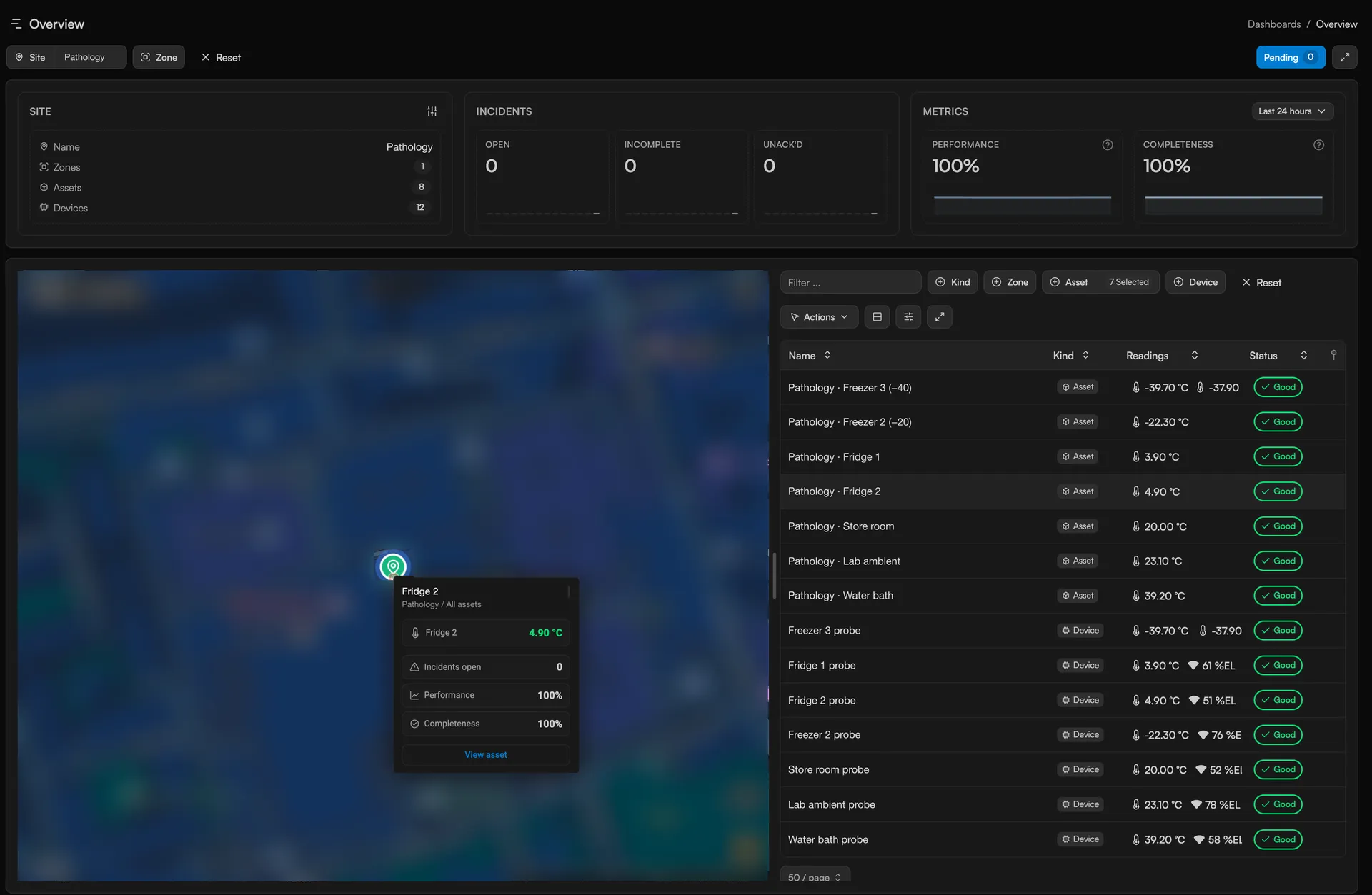
Because readings from every site arrive in one place, a manager can see all of their fridges, freezers and rooms on one dashboard, and a quality lead can compare sites rather than chasing paper logs from each one.
4. The alarm reaches a person
An alarm only helps if someone acts on it. A good system sends it by email, SMS, voice call or app push, in an order you choose, and escalates to the next person if nobody acknowledges it. The point is not a red light on a screen nobody is watching; it is a named person who knows within minutes that a unit has left its range.
Alarms should also cover the system itself: a sensor that stops reporting or a gateway that goes offline. Those are the faults that otherwise leave you with a silent gap in the record. Read more about alarms and reporting.
5. The record answers the inspector
Every reading, alarm, acknowledgement and note is kept as an audit trail. When an inspector asks what happened to the fridge on a given night, you can show the trace, when the alarm went, who responded, what they did and whether the stock was affected. That is the evidence regulators and standards look for, whether it is the MHRA under GDP, the Green Book for vaccines, ISO 15189 for labs or BRCGS for food.
Monitoring does not make you compliant by itself. It gives you the evidence that your storage stayed in range, and the record of what you did when it did not. What to record after an excursion is covered in temperature excursions.
Where these systems are used
- Healthcare: vaccine and medicine fridges, blood fridges and pharmacy stores. See healthcare.
- Pharmaceutical distribution: warehouses, cold rooms and vehicles under a wholesale dealer's authorisation.
- Laboratories and research: sample freezers, incubators and reagent stores. See pathology and labs.
- Food: cold stores, chillers, freezers and refrigerated transport. See food and cold storage.
What to look for when choosing one
Most systems have the same four parts, so the differences are in the detail. Ask how the sensors are calibrated and who holds the accreditation, what happens to readings when the network drops, how alarms escalate and whether they cover sensor faults, and who installs, maintains and supports it once it is in. Our buyer's guide sets out the questions in full.
Questions people ask
What is Sematics?
Sematics is the cloud monitoring platform behind the systems we install. It collects readings from sensors, checks them against your limits, raises alarms and keeps the audit trail and reports. JTF designs, installs, calibrates and supports it in the UK.
What happens to readings if the power or network goes down?
Our Node+ sensors run on batteries, so a mains failure does not stop them logging. If the network drops they store up to 100 days of readings and resend them automatically when the connection returns, so the record has no gap.
Does a monitoring system make us compliant?
No system does that on its own. It gives you the evidence that storage stayed in range, alarms that reach a person, and a record of what was done after an excursion. Your procedures and the people following them do the rest.
How often should sensors be calibrated?
Usually once a year, or as your quality system or standard sets out. Calibration shows each sensor still reads correctly. We calibrate temperature in our own UKAS accredited calibration laboratory No. 10723 (accredited to ISO/IEC 17025) and other parameters through accredited partners.
Can door sensors help explain an excursion?
Yes. A door sensor logs when a door opens and for how long, so a rise in temperature can be matched to a long door opening rather than a failing unit.
Sources
- EU Guidelines on Good Distribution Practice of medicinal products for human use (2013/C 343/01), applied in Great Britain by the MHRA
- UKHSA, The Green Book, chapter 3: Storage, distribution and disposal of vaccines
- ISO 15189:2022 Medical laboratories: requirements for quality and competence
- BRCGS Global Standard for Food Safety, Issue 9