The cold chain is the unbroken, documented sequence of temperature-controlled storage and transport from supplier to customer. Managing it well means every stage is controlled, monitored and recorded, so a product's temperature history can be shown from the moment it was collected to the moment it was delivered.
This guide covers the stages of a food cold chain, where it usually breaks, what auditors look for, five practices that close the gaps, and a simple monitor, act, improve plan for putting them in place. It's written for food logistics, but the same principles apply to medicines and healthcare stock.
Why cold chain control matters
From chilled dairy to frozen proteins and high-risk ready meals, a product's safety and shelf life depend on it staying within its temperature range the whole way. Temperature control isn't only a legal duty; it's the first defence against spoilage, food safety incidents and rejected deliveries. In England, most chilled food must be kept at 8 °C or below under the Food Safety and Hygiene (England) Regulations 2013, and quick-frozen food at −18 °C or colder.
The stages of the cold chain
| Stage | Objective |
|---|---|
| Supplier collection and pre-chill | Product enters the chain at the correct temperature |
| Cold storage at distribution centres | Stores hold their set points, including during loading |
| Vehicle loading and transport | No temperature spikes during handover or transit |
| Retail or end-customer delivery | Product integrity is kept right to the point of delivery |
Common cold chain challenges
| Challenge | Impact |
|---|---|
| Inconsistent loading temperatures | Early spoilage or failed delivery checks |
| Unmonitored transport | Excursions go unseen; loads are rejected |
| Poor record-keeping | Gaps at HACCP reviews and traceability audits |
| Driver and handling habits | Doors open too long, vehicles parked in the sun |
| Manual logging | Missed readings, transcription errors, records that can't be trusted |
| Packaging and insulation | Product exposed during transit or while waiting on the dock |
What auditors and customers look for
The frameworks that apply to most food logistics businesses are your HACCP plan, the BRCGS Food Safety or Storage and Distribution standard if you're certified, Food Standards Agency guidance, and your retail customers' own codes of practice. None of them prescribes a particular monitoring system, but between them an auditor will expect to see:
- temperature records for every critical control point, with no gaps;
- historical data you can produce on the day;
- sensors with current calibration certificates;
- a documented corrective action for every excursion;
- regular internal reviews, with an audit trail of who changed what.
Continuous electronic monitoring is the simplest way to meet all five at once. See temperature excursions: what to do and record.
Five best practices for cold chain control
1. Real-time monitoring in vehicles
Continuous in-transit monitoring is the backbone of a reliable cold chain. Temperature sensors and vehicle trackers send live data to your operations team, with alarms raised as readings drift towards a limit. That gives you time to act: call the driver, divert to the nearest depot, adjust the unit or hold the delivery. Make sure the system logs every reading for later analysis, not just the excursions.
2. Door and loading zone visibility
Door openings are one of the biggest causes of excursions in transit and at the dock. Door switches show exactly when and for how long doors are open during loading, unloading and deliveries, which exposes habits such as trailer doors left open during route planning. Door data next to temperature data shows the root cause of each deviation.
3. Calibrated equipment
A reading is only as trustworthy as the sensor that took it. Traceable calibration gives measurement traceability that stands up at inspection; choose UKAS accredited calibration where a customer, standard or regulator asks for it. We offer calibration for every sensor we supply: traceable to national standards as standard, or UKAS accredited where you need it (temperature in our own UKAS accredited calibration laboratory No. 10723, accredited to ISO/IEC 17025; other parameters through accredited partners). Match each certificate to the sensor's serial number, keep certificates where an auditor can see them (ideally on the monitoring platform), and recalibrate or swap sensors before certificates expire. See calibration.
4. Storage and transport on one platform
Cold chain control is strongest when storage and transport report to the same place. One platform for warehouse and vehicle monitoring closes the visibility gap at handover, gives one record from depot to delivery, cuts the admin of combining reports and speeds up root-cause investigations. The Sematics platform holds both.
5. Automated escalation
Checking for deviations by hand is slow and easy to miss. Rules-based alarms route the right alert to the right person as soon as an issue starts, with escalation by severity, time of day or product. Built-in workflows prompt the team to record the cause, the corrective action and what will stop it happening again, which becomes the audit trail. See alarms and reporting.
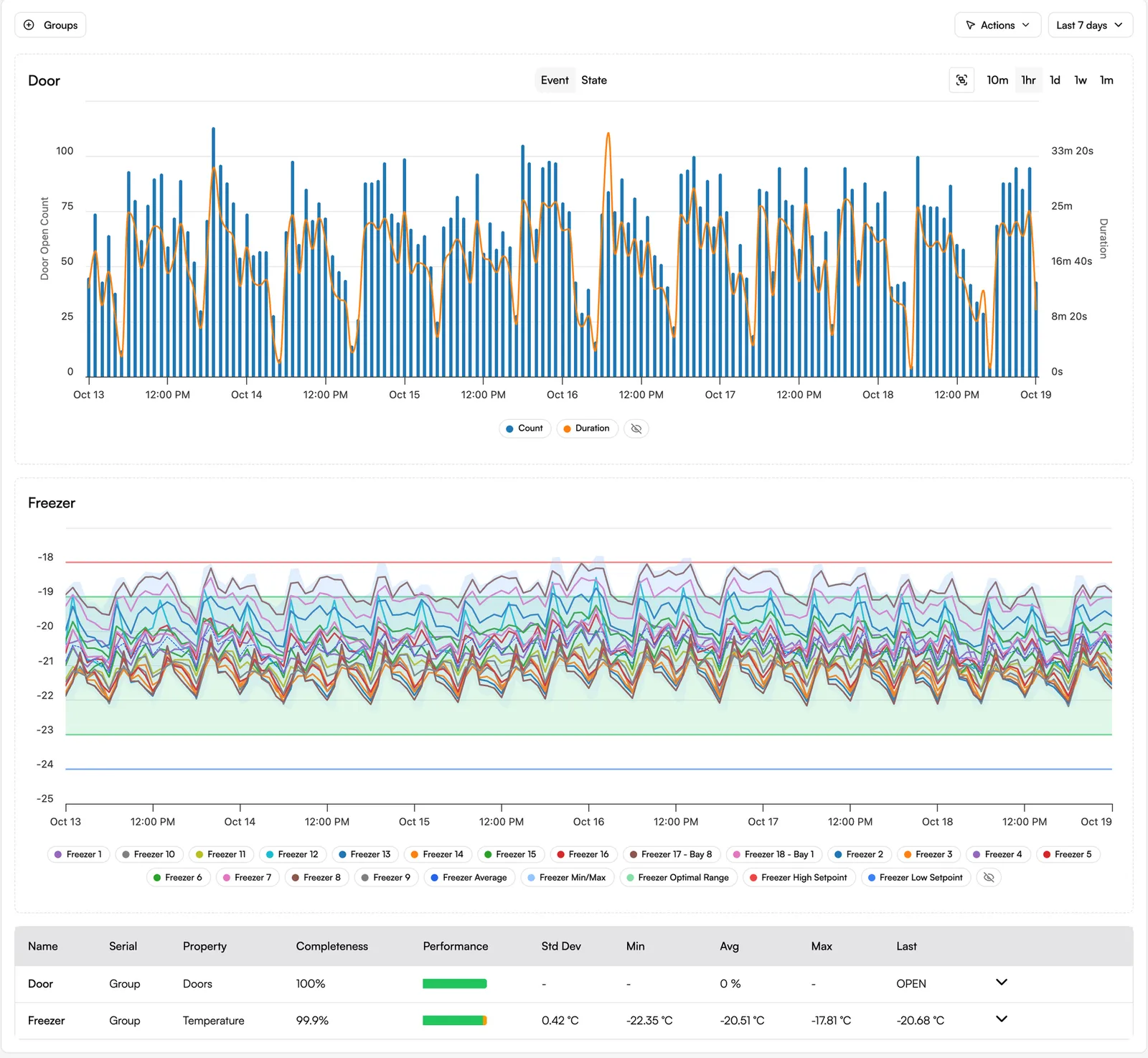
Run inside the range, not at its edge
Good performance isn't just avoiding the limits; it's staying well inside them. A unit held near the middle of its range works under less stress, uses less energy and gives you more time when something goes wrong. Trend data shows gradual drift or signs of equipment fatigue before they become critical.
Use that data to plan maintenance, such as coil cleaning or replacing a failing fan, before the fault. History also shows recurring patterns, such as seasonal rises or frequent door openings, that undermine stability. Dealing with them early reduces excursions and avoids unnecessary downtime. For the energy side, see cutting cold store energy costs.
Putting it in place: monitor, act, improve
- Operations and JTFMonitorFirst
- Fit sensors in vehicles and stores
- Calibrate every sensor
- Log temperature and door status continuously
- Shift leads and transportActEvery day
- Set alarm limits and escalation
- Train teams to respond
- Record corrective actions
- Technical and managementImproveMonthly
- Review excursion reports
- Fix recurring causes
- Refine loading and alarm rules
Accurate records, faster corrective action, fewer repeat incidents
A simple framework for introducing cold chain monitoring.
Technology alone isn't enough. Staff need to be confident reading alerts and dashboards and know what to do when an alarm comes in. Routine checks of refrigeration units, seals and sensors keep the system trustworthy, and a service partner who designs, installs, trains and supports the system keeps it working after the first month. See installation and support.
Cold chain action checklist
- Audit your current monitoring coverage, including every handover.
- Replace manual logs with automated monitoring.
- Make sure every sensor has a current calibration certificate: traceable as a minimum, UKAS accredited where a customer, standard or regulator requires it.
- Add door switches to vehicles and cold rooms.
- Bring fleet and warehouse data onto one platform.
- Set escalation rules so alarms reach someone who can act.
What results look like
Two food customers show what consistent monitoring can deliver. Nestlé's UK warehouse runs at 99% optimal temperature performance on JTF monitoring, with 100% data completeness (case study). A 25-site food distributor raised optimal performance across its estate after fixing misleading readings and acting on its reports (case study).
Over 95%
optimal performance across a 25-site food distributor, many sites at 99%
A 25-site UK food distributor on JTF monitoring and Sematics.
Questions people ask
What temperature should chilled food be kept at during distribution?
In England, most chilled food must be kept at 8 °C or below under the Food Safety and Hygiene Regulations 2013, and many businesses and retail customers set tighter limits of their own. Quick-frozen food should be at −18 °C or colder.
What reports does Sematics produce?
Scheduled compliance reports, performance dashboards and incident logs, including each alarm, who acknowledged it and the corrective action recorded. They can be produced on the day an auditor asks.
Who is JTF Wireless, and how does it support Sematics?
JTF Wireless is the UK service partner for Sematics. We design the system, install it, train your team, calibrate the sensors and support it for the life of the contract.
How quickly can a system be up and running?
Sensors, alarm limits and escalation contacts are set up on the platform before installation, based on what your team tells us, so readings and alarms work from the day the sensors go in.
Does one platform cover both stores and vehicles?
Yes. Sensors in cold rooms, freezers, trailers and vans report to Sematics, so you have one record from depot to delivery and can see exactly where a problem started.
Sources
- The Food Safety and Hygiene (England) Regulations 2013, Schedule 4 (temperature control)
- Food Standards Agency: chilling (food hygiene for businesses)
- BRCGS Food Safety (Issue 9) Standard
- BRCGS Storage and Distribution (Issue 4) Standard
- UKAS schedule of accreditation 10723 (JTF Wireless Ltd, calibration)