End-to-end cold chain monitoring means one continuous temperature record for a product, from the store it left to the door it arrived at, on one platform. When something goes wrong, you can see at which stage, at what time and under whose care, rather than stitching together a warehouse system, a vehicle logger and a delivery note.
Most operations still run separate systems for depots, vehicles and storage. A warehouse uses one platform, the fleet another, and drivers download loggers by hand. This guide shows where the risks sit along a product's journey, what each stage needs to evidence, and how a single platform closes the gaps between them.
The problem with separate systems
When each stage has its own system, the record breaks at every handover. Three failures come up again and again:
- Excursions missed at handovers. The store's record ends at the dock door and the vehicle's starts when the engine runs. The ten minutes on the bay belong to nobody.
- Faults found late. A refrigeration unit that drifts slowly shows up in one system but is never compared with the next stage.
- Audits built on paper. Pulling logger downloads, spreadsheets and printouts together for an auditor takes days, and gaps are hard to explain.
The result is that problems are found after the damage is done, and nobody can say for certain where they began.
Where the risks live along the journey
- Storage at the depotRefrigeration faults, poor air circulation, power cuts, doors left open.
- LoadingLong door openings, loading into a trailer that has not been pre-cooled, no record of load conditions.
- In transitRefrigeration failure, unplanned stops, door openings on multi-drop routes.
- Delivery and handoverNo handover temperature, unexplained delays, unclear responsibility at the door.
The four stages every temperature-sensitive delivery passes through.
A logger in a fridge does not cover the handover. A vehicle alarm does not explain a failed delivery. Only a record that follows the product through all four stages closes these gaps.
What one platform changes
Putting fixed sites, vehicles and portable boxes on one platform does more than collect data in one place:
- One record per product journey, with temperature, time, location and door events in sequence.
- One set of rules for alarm limits, delays and escalation across every site and vehicle, so reports compare like with like.
- One alarm path by email, SMS, voice call or app push, escalating to the next person if nobody responds.
- One audit trail of readings, alarms, acknowledgements, notes and calibration certificates for the auditor or inspector.
On the Sematics platform, Node+ sensors in stores and cellular trackers with Bluetooth sensors in vehicles report side by side. See how temperature monitoring systems work for the chain behind each reading.
What each sector has to evidence
| Sector | Rules and standards | What an excursion can cost |
|---|---|---|
| Food logistics | Food hygiene regulations (temperature control), BRCGS Food Safety and Storage and Distribution, HACCP, retailer audits | Rejected loads, waste, a failed audit, reputational damage |
| Pharmaceutical distribution | GDP, MHRA inspection of wholesale dealers, a documented investigation of every excursion | Quarantined or destroyed stock, inspection findings, risk to patients |
| Healthcare | Green Book for vaccines, CQC, HTA for tissue, Blood Safety and Quality Regulations, ISO 15189 for labs | Wasted vaccines and blood, revaccination, risk to patient care |
These are chain-wide responsibilities, not site-level ones. A wholesale dealer is accountable for the stock in the vehicle as much as on the shelf. Read more on MHRA GDP, the Green Book and BRCGS.
Common uses across a supply chain
| Use | What it does |
|---|---|
| Cold store and depot monitoring | Continuous temperature, humidity and door records with alarms, for every store and cold room |
| In-transit visibility | Live location and load condition, so you can reroute, warn the customer or act on a fault |
| Fleet maintenance | Vehicle and refrigeration fault data, so units are repaired before they fail on the road |
| Inventory and asset tracking | Where trailers, cages and cold boxes are, and the conditions they have been kept in |
Closing the handover gap
Handovers are where separate systems fail, so they deserve their own plan. Three practical steps make the biggest difference:
- Pre-cool and record it. Log the trailer or box temperature before loading starts, so the record shows it was ready.
- Watch the bay. Monitor loading-bay doors and dock areas, not just the store and the vehicle, so time on the bay is in the record.
- Record the handover. Capture the load temperature and time at delivery, so responsibility at the door is clear if a customer rejects the load.
Scaling across sites and fleets
A system for a national network should start small and grow without changing shape. In practice that means you can:
- Start with one fridge or one vehicle and add sites, fleets and asset types later
- Apply the same alarm rules and reports at every site
- Set escalation by site or role, with a roll-up view for regional and national managers
- See every vehicle's location, temperature and status alongside the stores they serve
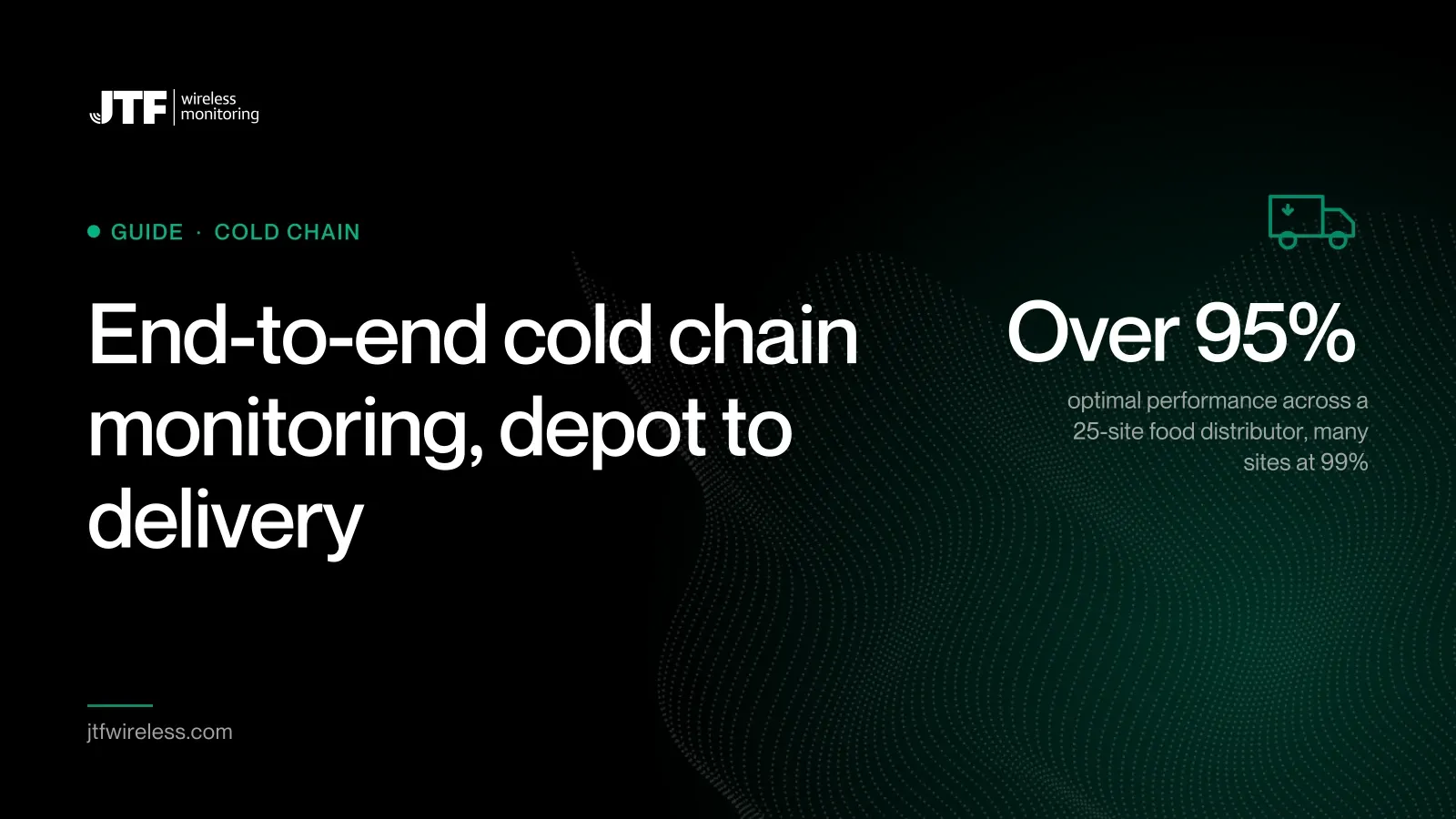
Scale works in practice. Over 95% optimal performance across a 25-site food distributor we monitor, with many sites at 99%, and 99% optimal temperature performance at Nestlé UK & IRE's UK warehouse, with 100% data completeness. Read the 25-site food distributor and Nestlé case studies.
Over 95%
optimal performance across a 25-site food distributor, many sites at 99%
A 25-site food distributor monitored on Sematics.
What comes next
- Earlier warnings. Trend data that flags a refrigeration unit drifting before it fails.
- Energy and waste. The same readings show where cold stores and vehicles use more energy than they need. See cold store energy.
- Faster networks. Better cellular coverage for vehicles, and long-range LoRaWAN for large sites.
How JTF delivers it
We design the system across your stores and fleet, install sensors, gateways and trackers, and support it afterwards. We provide calibration for every sensor we supply: traceable to national standards as standard, or UKAS accredited where you need it (temperature in our own UKAS accredited calibration laboratory No. 10723, accredited to ISO/IEC 17025; other parameters through accredited partners), with certificates stored on the platform. Validation, temperature mapping and regular service reviews sit alongside it. See monitoring and the hardware guide.
Questions people ask
What is end-to-end cold chain monitoring?
One continuous temperature record for a product from storage, through loading and transport, to delivery, on one platform. It lets you see where and when an excursion happened, rather than piecing it together from separate systems.
Can one platform monitor stores and vehicles?
Yes. On Sematics, LoRaWAN sensors in buildings and cellular trackers in vehicles report side by side, with the same alarm rules, reports and audit trail.
What reports does the platform produce?
Temperature records, alarm and incident logs, performance reports and calibration certificates, for your own reviews and for auditors or inspectors.
Why are wireless sensors cheaper to install?
LoRaWAN sensors run on batteries and need no cabling, and one gateway covers a large area, so installation is quicker and less disruptive. Calibration, battery changes and support are handled under a service agreement.
Sources
- EU Guidelines on Good Distribution Practice of medicinal products for human use (2013/C 343/01), applied in Great Britain by the MHRA
- MHRA: Good manufacturing practice and good distribution practice (GOV.UK)
- UKHSA, The Green Book, chapter 3: Storage, distribution and disposal of vaccines
- BRCGS Food Safety (Issue 9) Standard
- BRCGS Storage and Distribution (Issue 4) Standard
- The Food Safety and Hygiene (England) Regulations 2013, Schedule 4 (temperature control)
- Human Tissue Authority: codes of practice and standards (including the post-mortem sector)
- The Blood Safety and Quality Regulations 2005
- ISO 15189:2022 Medical laboratories: requirements for quality and competence