The hidden temperature risks in a hospital are rarely the main medicines fridge. They are the issue fridge opened all through a shift, the incubator nobody owns, the walk-in cold room during a delivery, the trolley waiting in a corridor and the ageing freezer that drifts at 3am. Each one is a place where an excursion can happen without anyone seeing it.
The fix starts with a list: every temperature-controlled place on site, what it holds, its limits, and whether it is monitored continuously with an alarm that reaches a person out of hours. We monitor 3,900+ assets at 77 sites across 25 NHS trusts, health boards and pathology networks, and the gaps below are the ones we find most often.
Blood banks and issue fridges
The main blood bank fridge is usually well watched. The risk sits beside it: issue fridges near theatres and wards, satellite fridges and any unit where doors open all day. Each opening lets warm air in, and a fridge that reads fine at the morning check can spend part of the afternoon above its limit.
Blood storage in the UK falls under the Blood Safety and Quality Regulations 2005, and transfusion labs will expect a record that covers every hour, not one reading a day. Continuous monitoring shows the pattern of door openings and recovery, which is often what a quality manager needs to decide whether a unit is in the right place.
Pharmacy fridges and freezers
Medicines carry labelled storage conditions, most often +2 to +8 °C for fridge lines. A min/max thermometer read once a day tells you the extremes but not when they happened or for how long, so it is hard to judge whether stock is still usable after a breach.
A continuous record answers those questions. It shows how long a fridge was out of range, how high it went and when it recovered, which is what a pharmacist needs to make a stock decision and what an inspector will ask to see. The NHS Specialist Pharmacy Service guidance on storing medicines in a fridge sets out the checks; our vaccines and pharmacy page covers how we evidence them.
Alarm raised, acknowledged and recorded
Illustrative. A compressor fault at night takes the fridge above +8 °C; the alarm reaches the on-call pharmacist before the morning check would have found it.
Laboratories, incubators and theatres
A hospital laboratory may hold fridges, freezers, ultra-low freezers and incubators side by side, each with different limits and different owners. When each unit is checked by hand, the busiest ones get missed first. Monitoring them centrally gives one view of every unit and removes most of the walking.
For accredited labs, the record also has to stand up to an assessor working to ISO 15189, including how sensor accuracy and measurement uncertainty feed into alarm limits. Our guide to measurement uncertainty in medical laboratories covers that in detail.
Theatres, sterile stores and clean rooms add room temperature and humidity to the list. They are often run by estates rather than the clinical team, which is exactly why they drop out of a ward-by-ward review.
Walk-in cold rooms and staging areas
Large cold rooms behave differently from fridges. Frequent access, loading and dense stock all change the conditions inside, and the air near the door can be warmer than the air at the back. One probe in the middle does not tell you what happens at the edges; a mapping study shows where the warm and cold spots are and where permanent sensors should sit.
Temperature risk does not begin inside the store. Medicines, samples and blood move between pharmacy, laboratories, wards and vehicles, and they can wait in corridors or loading bays on the way. Monitoring those transition points, or the boxes that travel through them, shows where exposure happens.
Ageing equipment and out-of-hours failures
Temperature data is also a record of how well a unit is working. A fridge that takes longer to recover after each door opening, or one that runs a little warmer each month, is often heading for failure. Spotting that trend gives estates time to repair or replace it before stock is lost.
Hospitals run around the clock, and failures do too: overnight, at weekends and on bank holidays. An alarm that only shows on a screen in an empty office is not an alarm. Monitoring needs to send alerts by text, call or email to a named person on call, and to record who acknowledged it and what they did. See alarms and reporting for how that works on Sematics.
- 02:10Fridge goes above limit
- 02:15Alarm reaches on-callText and call to the named person
- 02:19AcknowledgedWho, when and what they found
- 02:40Stock movedTo a monitored fridge in range
- 09:00Decision recordedPharmacist reviews the trace and signs off
Illustrative times. The steps are what an inspector will want to see in the record.
Turning hidden risks into evidence
Sensors are the start. How you set up and use them decides whether the record helps you or just adds noise.
- List every location. Pharmacy, pathology, blood, theatres, wards, cold rooms and staging areas, with the limits and owner for each.
- Monitor continuously. Wireless sensors send readings through the day and night, so the record covers the hours nobody is there.
- Cut alarm fatigue. Set delays and group alarms so staff respond to real events, not to a door left open for a minute.
- Link alarms to your quality system. Each excursion should lead to a recorded response, and where needed a root-cause review and corrective action.
- Name who responds. Assign each alarm to a role and a rota, with escalation if nobody acknowledges.
- Train and drill. Hands-on sessions help staff read an alert and act; a simulated night-time failure shows where the response breaks down.
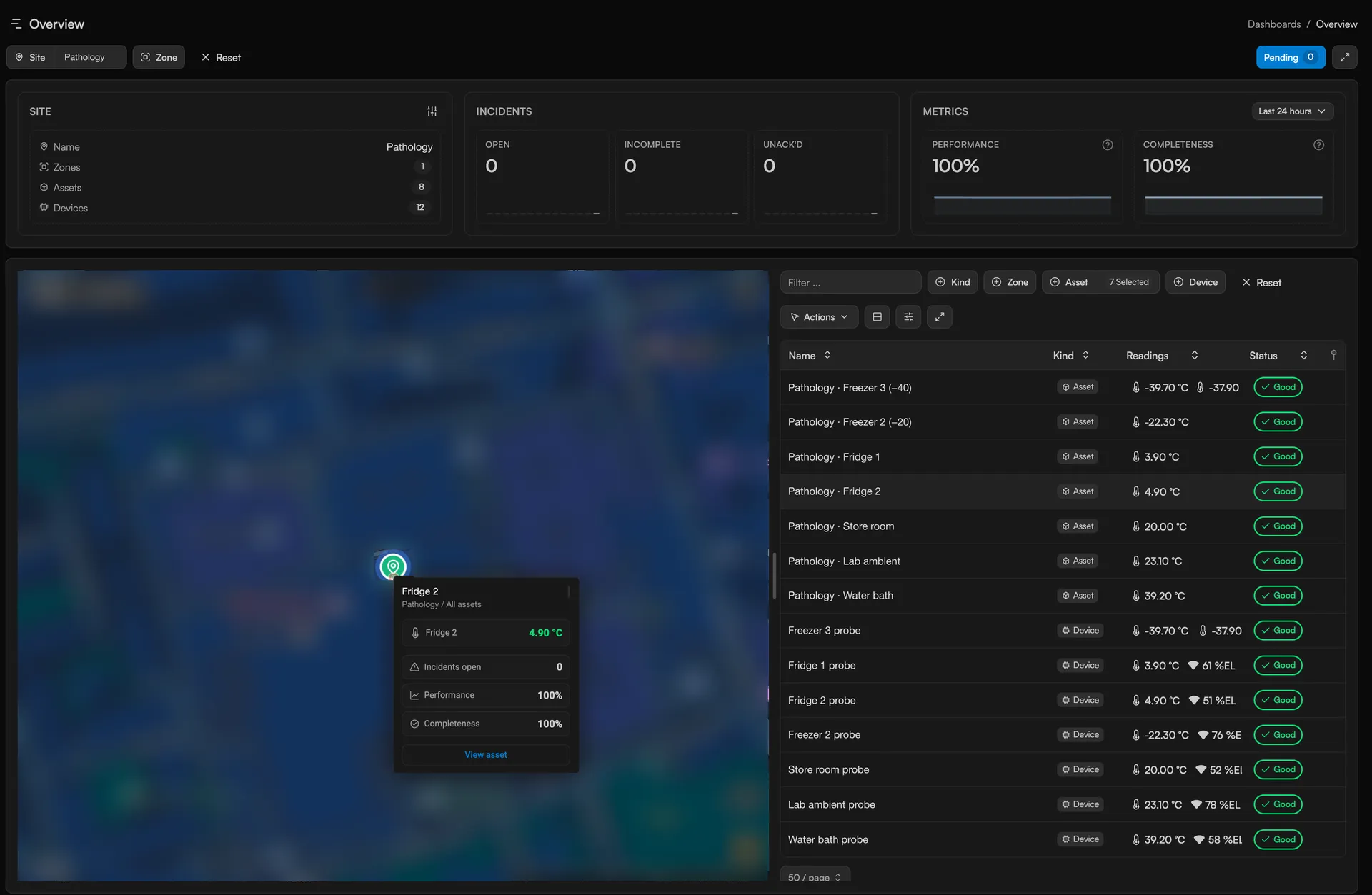
We provide continuous monitoring through Sematics, with live and historical data, alarm histories and reports from one platform, plus calibration and installation and support from our own engineers.
Questions people ask
Which areas of a hospital need temperature monitoring?
Any place that holds something with a stated temperature range: pharmacy fridges and freezers, blood bank and issue fridges, laboratory fridges, freezers and incubators, walk-in cold rooms, theatres and sterile stores, and staging areas where stock waits. Start with a list of every location, its limits and its owner.
Is a daily min/max check enough?
It tells you the highest and lowest readings since the last reset, but not when they happened or for how long. That makes it hard to judge whether stock is still usable after a breach. Continuous monitoring gives the duration and timing an inspector or pharmacist needs.
How do we stop staff ignoring alarms?
Set sensible delays so a brief door opening does not alarm, group related alarms, and route each one to a named role with escalation. Review alarm history regularly and remove the causes of repeat alarms rather than living with them.
Who is JTF Wireless, and how does it relate to Sematics?
JTF Wireless is the UK service partner for Sematics. We design, install and support Sematics monitoring systems, provide calibration, and train the teams who use them.