Environmental monitoring in healthcare is the continuous, recorded control of the conditions that keep medicines, blood, diagnostic samples and human tissue safe. Each place has its limits, its alarms and a named owner, and every excursion has a recorded response.
Different bodies look at different parts of a site, but they ask for the same thing: evidence. We monitor 3,900+ assets at 77 sites across 25 NHS trusts, health boards and pathology networks, and this guide sets out what each body covers, where monitoring is needed and what a record that holds up looks like.
Why environmental monitoring is clinical infrastructure
From blood fridges to pharmacy stores, vaccine rooms to cryogenic tanks, the conditions are part of the care. When control fails, the consequences are clinical, not just administrative:
- critical samples, blood products or medicines are lost;
- medicines or vaccines that have degraded may be given to patients;
- diagnostic samples become invalid and results are wrong or delayed;
- inspections and assessments raise findings, and regulators can take action.
A fridge without monitoring, or an alarm nobody answers, is a patient safety risk. Treating monitoring as part of the clinical estate, with owners and reviews, is how hospitals avoid it.
Who looks at what
Healthcare providers work under several bodies, each with its own remit. UKAS is an accreditation body rather than a regulator: it assesses laboratories against standards such as ISO 15189.
| Body | Applies to | What it looks at |
|---|---|---|
| CQC | Hospitals, clinics, GP practices and care providers | Safe care and treatment, including proper and safe management of medicines (regulation 12) |
| MHRA | Medicines storage and distribution; blood establishments and hospital blood banks | Storage within labelled conditions; Blood Safety and Quality Regulations 2005 |
| UKAS | Pathology and blood sciences laboratories seeking accreditation | ISO 15189: equipment, calibration, measurement uncertainty, records |
| HTA | Human tissue, post-mortem and mortuary facilities | Codes of practice and licensing standards, including storage conditions |
| NHS trust | Internal quality, SOPs and estates | Local policy, audits and estates monitoring |
Despite different remits, they share one demand: reliable monitoring backed by documented evidence. Vaccine storage also follows the Green Book, and medicines distribution follows MHRA GDP.
The areas that need monitoring
Each area has its own limits and escalation, so each needs its own set-up:
| Area | Monitoring focus |
|---|---|
| Pharmacy fridges and freezers | Temperature within labelled storage conditions for medicines and vaccines, usually +2 to +8 °C for fridge lines. |
| Vaccine rooms and drug stores | Room temperature, and where relevant humidity and door access. |
| Blood fridges and pathology laboratories | Cold storage for blood, samples and reagents, with records an assessor can follow. |
| Cryogenic storage and liquid nitrogen tanks | Low temperature for tissue, IVF material and biologics, under HTA and HFEA rules. |
| Operating theatres and clean rooms | Temperature and humidity for sterile conditions. |
| Mortuaries | Body store temperatures and an audit trail under HTA standards. |
Our article on hidden temperature risks in healthcare covers the places that are most often missed, such as issue fridges and staging areas.
What a defensible record looks like
Compliance goes beyond a logger on the wall. It is a system in which each measurement can be trusted, each deviation is acted on and each record is ready for scrutiny.
- Continuous and automatic. Readings are taken through the day and night and stored securely, with nothing to transcribe.
- Alarms that reach a person. Excursions trigger alerts by text, call or email to a named role, with escalation if nobody responds.
- A recorded response. The record shows who acknowledged the alarm, when, and what they did with the stock.
- Calibration. Every sensor has an in-date certificate available on request. We provide calibration for every sensor we supply: traceable to national standards as standard, or UKAS accredited where you need it (temperature in our own UKAS accredited calibration laboratory No. 10723, accredited to ISO/IEC 17025; other parameters through accredited partners).
- Regular review. Monthly or quarterly QA reviews of alarms, trends and calibration status.
- Validation. Where your quality system needs it, the system is validated against documented requirements.
Setting alarms that people trust
Alarms only protect stock if staff believe them. Set a short delay so a door opened for a delivery does not alarm, and set limits from the storage conditions, adjusted for measurement uncertainty where your decision rule requires it. Route each alarm to a role rather than a person, so it still reaches someone when staff change shifts or go on leave.
Review repeat alarms every month. A unit that alarms most days is telling you something: it may be overfilled, badly placed, near a heat source or close to failure. Fix the cause rather than widening the limit, and record what you changed.
Humidity, rooms and plant
Rooms matter as much as fridges. Medicines stored at room temperature have limits too, often up to +25 °C, and theatres and sterile stores have humidity ranges set by your estates and infection control policies. Monitoring these with the same platform as the fridges gives one record for the whole site, and estates can see plant trends before a room goes out of range.
Who does what
Monitoring works when estates, quality and clinical teams see the same data and know their part. A typical split looks like this:
- Pharmacy leadPharmacy
- Fridge and store limits
- Stock decisions after an excursion
- Medicines records for CQC and MHRA
- Quality managerPathology and blood
- Decision rules and alarm limits
- Calibration certificates for ISO 15189
- Blood storage records
- Estates managerEstates
- Cold rooms, theatres and plant
- Equipment trends and repairs
- Out-of-hours escalation
- Ward or clinic managerWards and clinics
- Medicines and vaccine fridges
- First response to alarms
- Daily sign-off
A typical hospital set-up. Your roles and rota will differ.
In Sematics, each team sees its own units on a dashboard across one site or many, while QA keeps one view of the whole estate. Reports and alarm histories come from the same record, so there is one version of the truth at inspection.
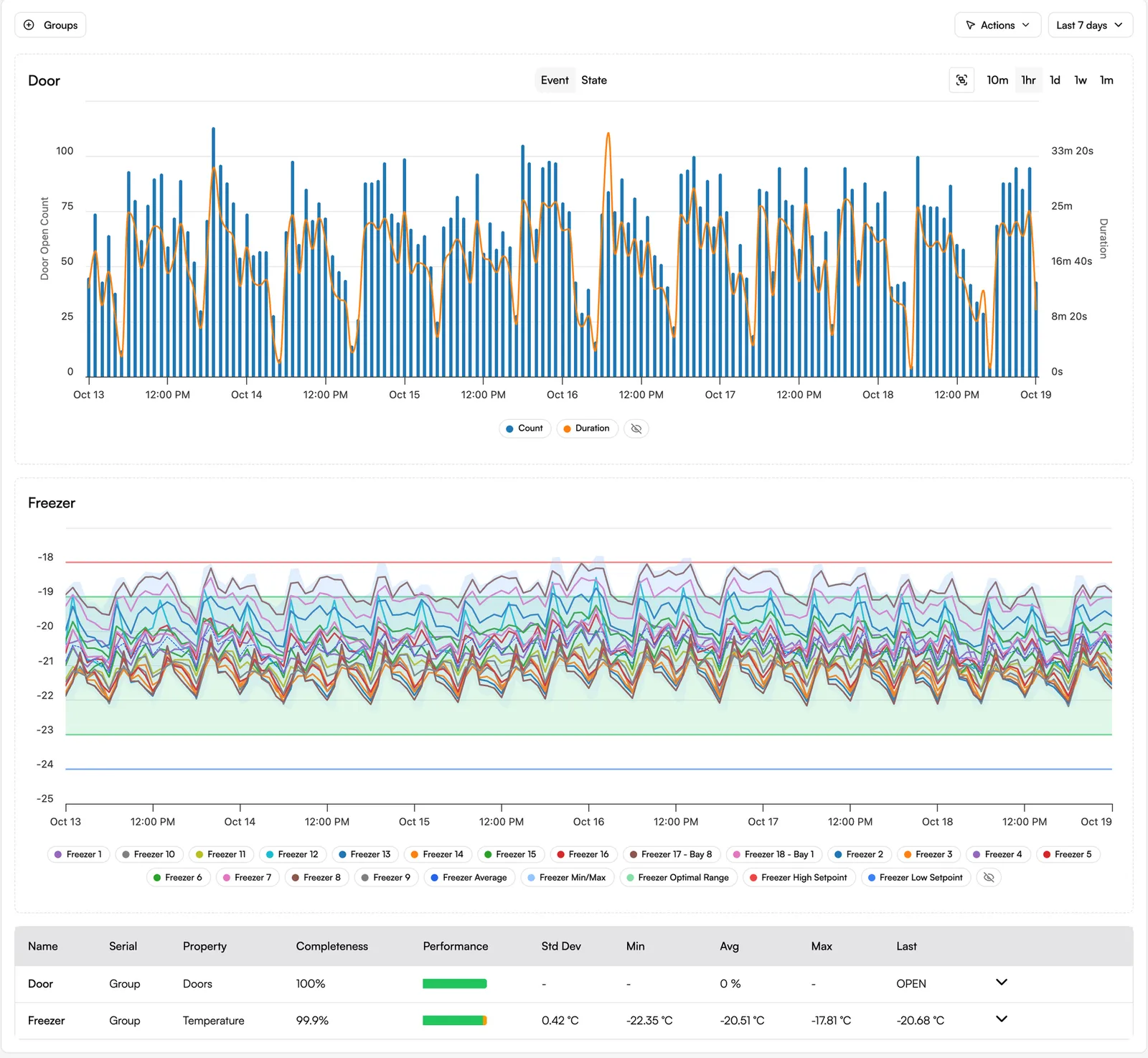
In practice: two NHS trusts
At Wye Valley NHS Trust, the pathology team's UKAS assessors look at the Sematics system at every assessment visit.
“They always come and they always look at the Sematics system and they're always happy with what we do.”
At University Hospitals of Leicester, we monitor 350+ assets across three hospitals on one platform, with one set of alarms and reports.
Getting started
Start with a list of every temperature-controlled place on site, its limits, its owner and how it is monitored today. Then close the gaps: unmonitored units first, then alarm routing, then calibration and records. We design, install and support the system, calibrate the sensors and train the teams; see monitoring and installation and support.
Questions people ask
Is UKAS a regulator?
No. UKAS is the UK's national accreditation body. It assesses laboratories against standards such as ISO 15189 and ISO/IEC 17025. Regulators such as the MHRA, CQC and HTA set and enforce the rules.
Which hospital areas need environmental monitoring?
Pharmacy fridges and freezers, vaccine rooms and drug stores, blood fridges and pathology labs, cryogenic storage, theatres and clean rooms, and mortuaries. Each has its own limits and owner, so each needs its own alarm set-up.
How often should we review the monitoring system?
Most sites review alarms, trends and calibration status monthly or quarterly, as part of their quality system. Calibration is usually annual, with reminders before each certificate expires.
Can one system cover several sites?
Yes. Sematics shows every site on one dashboard, with each team seeing its own units and QA seeing the whole estate.
Sources
- CQC: GP mythbusters (includes vaccine storage)
- Health and Social Care Act 2008 (Regulated Activities) Regulations 2014, regulation 12 (safe care and treatment)
- MHRA: Good manufacturing practice and good distribution practice (GOV.UK)
- The Blood Safety and Quality Regulations 2005
- Human Tissue Authority: codes of practice and standards (including the post-mortem sector)
- UKAS: Medical laboratory accreditation (ISO 15189)
- ISO 15189:2022 Medical laboratories: requirements for quality and competence
- UKHSA, The Green Book, chapter 3: Storage, distribution and disposal of vaccines